The sun is sinking slowly over the Mediterranean. A yacht lies at anchor a short distance from the Valencian coast. On the aft deck, a string quartet is tuning. The opening bars of a Mozart adagio rise into the warm evening air, carried on the sea breeze, suspended between the lapping of the waves and the attentive silence of the guests. This is what a classical concert on a private yacht is: the improbable, yet deeply natural, meeting of Europe's great musical heritage with the boundless blue of the sea.
The tradition is no contemporary invention. From the Republic of Venice to the court of George I of England, from the river music of the Baroque to the Venetian serenate of the eighteenth and nineteenth centuries, music has always found in water an exceptional setting. Our own age, rediscovering the luxury of slowness and intimacy, is reviving this ancient dialogue between the waves and the score. To organise a classical music yacht charter in the Mediterranean is to inscribe your event — a wedding, a milestone birthday, a discreet celebration or a corporate reception — within a lineage that runs through several centuries of European refinement.
This long-form guide is written for those who are considering such an experience. We cover the historical traditions, the musical formations best suited to the sea, the choice of yacht, the repertoire, the leading destinations, the technical and culinary considerations, and the concrete steps of organisation. Whether you are planning an intimate gathering or a large-scale celebration, you will find here the points of reference needed to design a bespoke yacht concert that will remain in your guests' memory.
A European Tradition: Music on the Water
The idea of listening to music on the water is not the product of a passing fashion. It is rooted in several centuries of European history, in which the sea, rivers and lakes have served as the stage for some of the most celebrated musical moments in the Western canon.
Handel's Water Music: a royal Thames evening
The most famous example of all is George Frideric Handel's Water Music, composed in 1717 for a royal procession of King George I of England along the River Thames. On the evening of 17 July, the King and his court boarded a richly decorated barge at Whitehall and travelled upriver towards Chelsea. A second barge followed close behind, carrying fifty musicians — strings, oboes, bassoons, trumpets, horns and flutes — who performed Handel's new suites as the royal party drifted past Westminster, Lambeth and Vauxhall in the long summer twilight.
The contemporary Daily Courant reported that the King was so delighted that he commanded the entire work to be played three times that night — once on the way upstream, again at supper, and a third time as the royal barge made its return. No work of music has ever been more thoroughly identified with a single performance, and few have so completely captured the magic of an instrumental ensemble heard across water.
Three centuries on, the lesson of that Thames evening still holds. Music carried over the surface of the water possesses an acoustic clarity, a sense of occasion and an emotional resonance that no concert hall can quite match. When we design a private recital aboard a yacht in the Mediterranean, we are, in a real sense, continuing the line that began with Handel and his royal patron.
The Venetian serenate
In the Republic of Venice, the serenate sull'acqua had become, from the Renaissance onwards, a recognised art of living. Venetian patricians staged private concerts from their gondolas or from richly ornamented peote, in which voice, mandolin, theorbo and viol blended with the slow movement of the canals. This tradition left a deep mark on European chamber music; one still hears, in the Italian Baroque — and in Vivaldi above all — that particular sensitivity to the play of air and water.
Aldeburgh, Salzburg and the festival century
Closer to our own day, the great festivals have continued the conversation between place and music that began on the Thames and in the Venetian lagoon. Benjamin Britten's Aldeburgh Festival, founded in 1948 on the Suffolk coast, gave English audiences an enduring example of music heard within sight of the sea. In Austria, the Salzburg Festival has refined the art of staging chamber music in historic settings since 1920. And in London, the BBC Proms — the largest classical music festival in the world — keeps alive the older idea that great music belongs not in a single cathedral of culture, but wherever an attentive audience can be gathered.
A quiet renaissance
For the past two decades, private music on the water has been enjoying a quiet but pronounced revival. Floating festivals, musical cruises, weddings with a private classical recital on board: the western Mediterranean — and the Valencian coast and the Balearic Islands in particular — has emerged as one of the natural homes of this rediscovery. The reasons are at once aesthetic — the quality of the light, the intimacy, the beauty of the setting — and cultural: an international audience attentive to European heritage is increasingly seeking out experiences that move beyond the hotel ballroom and the marquee.
Why Choose a Classical Concert on a Yacht?
Before turning to practical detail, it is worth understanding what makes this format particular. Why choose the sea over a concert hall, a country house, or any other prestigious venue?
Acoustic intimacy
Aboard a yacht, the audience is necessarily small — from a handful of guests to eighty at most — which creates a proximity to the performers that no concert hall can offer. The most delicate nuances of a Chopin nocturne, the breath of the bow across a string, the soft fall of fingers on the keys of a piano: everything becomes audible. This is the precise opposite of the mass concert, and it is exactly what our clients are looking for.
A setting no designer could match
No scenographer can rival a Mediterranean sunset. The golden light slipping across the teak, the changing tones of the sea between indigo and turquoise, the silhouettes of islands on the horizon: together they compose a living stage that turns listening into a complete sensory experience. Classical music, which calls on the imagination as much as the ear, finds here an ideal field of expression.
Absolute exclusivity
Your musical event is strictly private. There is no anonymous public, no imposed programme, no ticket office: you choose the works, the performers, the guests, and the way the evening unfolds. This degree of freedom is rare, and it is one of the principal reasons families, couples and companies choose this format over more conventional alternatives.
Design your bespoke musical evening
Our team in Valencia can guide you through the choice of musicians, the repertoire and the yacht best suited to your event. Let us discuss your project, with no obligation.
An experience that endures in memory
The memory of an event is closely bound to its sensory dimension. A tasting, a scent, a melody: these are the sensory anchors by which exceptional moments survive in recollection. A concert at sea, by combining several senses at once — visual, auditory, olfactory — creates precisely this kind of deep anchor. Your guests will remember it for years, far more vividly than they would remember a more conventional reception.
The union of food and music
On board, music is not enjoyed in isolation. It enters into dialogue with the table, the wines, the service. This synergy between the art of living and the art of music belongs to a long European tradition of the cultivated banquet, from the academia of the Renaissance to the Mayfair drawing rooms of the nineteenth century. To stage it today, on the Mediterranean, is to carry forward that inheritance.
Musical Formations Suited to the Yacht
Not every ensemble lends itself equally to the maritime environment. Each instrument and each configuration carries its own acoustic, logistical and aesthetic constraints, which must be anticipated. What follows is an overview of the principal options and their particular character.
Solo piano: complete intimacy
Solo piano is perhaps the most emotionally charged of all formats. One performer, one instrument, and the full wealth of the keyboard repertoire unfolds before the listener. On a yacht of eighteen metres or more, installing a baby grand is technically possible, provided the logistics are handled with care: transport slings, protection against the saline humidity, and a tuning carried out immediately before the recital.
The keyboard repertoire offers an extraordinary range for an evening at sea. Debussy's Préludes — and above all La Cathédrale engloutie and Voiles — seem almost to have been written for the setting. Satie's Gymnopédies and Gnossiennes create the contemplative atmosphere that suits a sunset perfectly. Ravel, in Jeux d'eau or Une barque sur l'océan, celebrates the marine element directly. And Chopin — his nocturnes, his ballades — brings the elegant melancholy that marries so naturally with the fading Mediterranean light.
String quartet: the perfect balance
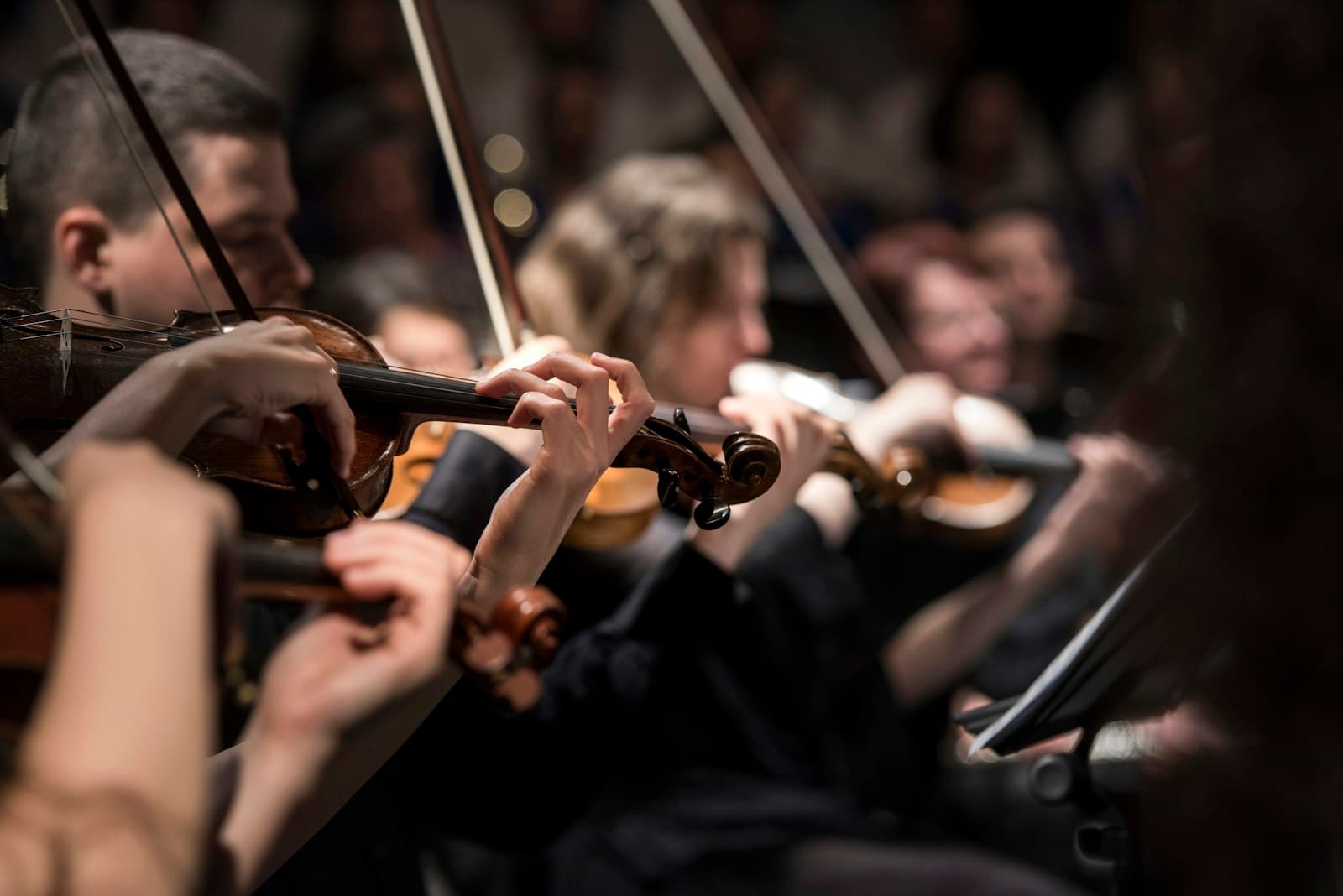
The string quartet on a yacht — two violins, viola, cello — is probably the most versatile and most-requested formation for an event at sea. Its dynamic range suits an audience of twenty to sixty people in the open air, its repertoire spans four centuries of chamber music, and the mobility of its players allows easy setup on the upper deck or in a large saloon.
The quartet repertoire offers limitless possibilities. Mozart's six Haydn Quartets, the late Beethoven, Haydn himself, but also Schubert's Death and the Maiden, the quartets of Mendelssohn and Brahms, and the more recent pages of Ravel, Debussy or Albéric Magnard — a rare French composer worth discovering, whose chamber works deserve a wider audience — make it possible to construct programmes of an hour to ninety minutes that hold attention from first bar to last.
Violin and piano duo: the chamber conversation
This formation is ideal for medium-sized yachts and for more intimate occasions. It evokes at once the great drawing rooms of the nineteenth century, where music was played and heard among friends and enlightened amateurs. The repertoire is vast: the sonatas of Brahms, Schumann and Beethoven; Franck's beloved Sonata in A; the haunting Mythes of Karol Szymanowski; the shorter pieces of Debussy and Elgar. The British tradition has a particular treasure here in Edward Elgar's Salut d'Amour, an unfailingly moving choice for a wedding or anniversary.
Solo cello: meditative depth
For guests who appreciate stillness and musical contemplation, a solo cello recital is an exceptional option. The six Cello Suites of Johann Sebastian Bach — those absolute monuments of the Baroque repertoire — acquire in a maritime setting an almost spiritual dimension. Modern works by Benjamin Britten (whose three solo Cello Suites were written for Mstislav Rostropovich), Zoltán Kodály, or the rare and magnificent Sonata for Solo Cello by Albéric Magnard — that rare French composer worth discovering — extend the possibilities further still.
Harp: the most "maritime" of instruments
If any instrument seems destined to be played at sea, it is surely the harp. Its crystalline timbre, its evocative repertoire, even its silhouette speak the language of water. The harp suits weddings and ceremonies particularly well, but also cocktail moments, to which it brings an immediately perceptible refinement. The repertoire is wide: Handel's harp concerto, Debussy's Danses sacrée et profane, the popular arrangements of Welsh and Celtic airs that resonate with British and Irish audiences, and the modern works of contemporary composers who have written extensively for the instrument.
Lyric voice: the great emotion
A soprano or tenor with piano accompaniment, performing a programme of arias and art songs, is one of the most moving propositions of all. The English song tradition — Purcell, Vaughan Williams's Songs of Travel, Britten's folk-song arrangements, Ivor Gurney's settings of Housman — sits at the very heart of British musical culture. The Italian and German lieder repertoire — Schubert, Schumann, Tosti, Bellini — opens an equally rich vein. For more dramatic moments, the great arias from Handel's operas, Mozart, Verdi, Puccini and Bizet's Carmen will reliably carry an audience away. Such a formation calls for discreet but careful sound reinforcement when performed in the open air.
Wind quintet and solo flute
The wind quintet — flute, oboe, clarinet, bassoon and horn — offers an exceptionally rich tonal palette and is perfectly mobile aboard a yacht. The flute in particular, whether solo or accompanied, has a natural affinity with the sea air. Bach's flute sonatas, Debussy's Syrinx for solo flute, and the pieces of Henry Purcell, Poulenc and Roussel are admirably suited to the setting.
Classical trio and other formations
The piano trio (violin, cello, piano) opens up the great trios of Beethoven, Schubert, Brahms, Ravel and Fauré. The string trio (violin, viola, cello) gives access to Mozart, Beethoven and Schoenberg. For the most prestigious events, an octet or a chamber ensemble of eight to twelve musicians, aboard a yacht of generous proportions, transforms the performance into a miniature symphonic concert in its own right.
Which formation for your event?
The choice depends on the number of guests, the yacht selected, the time of day and the atmosphere you wish to create. Our concierge will guide you towards the ideal formation and propose a programme tailored to your taste.
Choosing the Right Yacht for a Musical Event
Not every yacht is equally suited to hosting a concert. Size, interior layout, deck configuration, the quality of the soundproofing between spaces: all these directly influence the quality of the experience. Below are the essential criteria.
Size in relation to formation
A violin-and-piano duo can be accommodated comfortably on a yacht of fifteen to eighteen metres with a generous saloon. A string quartet ideally requires eighteen to twenty-two metres, with a clear upper deck or a substantial saloon. For a quintet or sextet with a baby grand, twenty-five metres is the minimum, on a yacht whose structure permits the installation of a heavy instrument. Beyond that — chamber ensemble, octet — yachts of thirty-five to fifty metres become necessary.
Along the Valencian coast and across the Balearics, our fleet offers yachts in each of these ranges. Our luxury yacht charter options from twenty-four metres upwards cover most private concert yacht configurations and can comfortably host twenty to forty guests in optimal conditions.
Acoustic: deck or saloon?
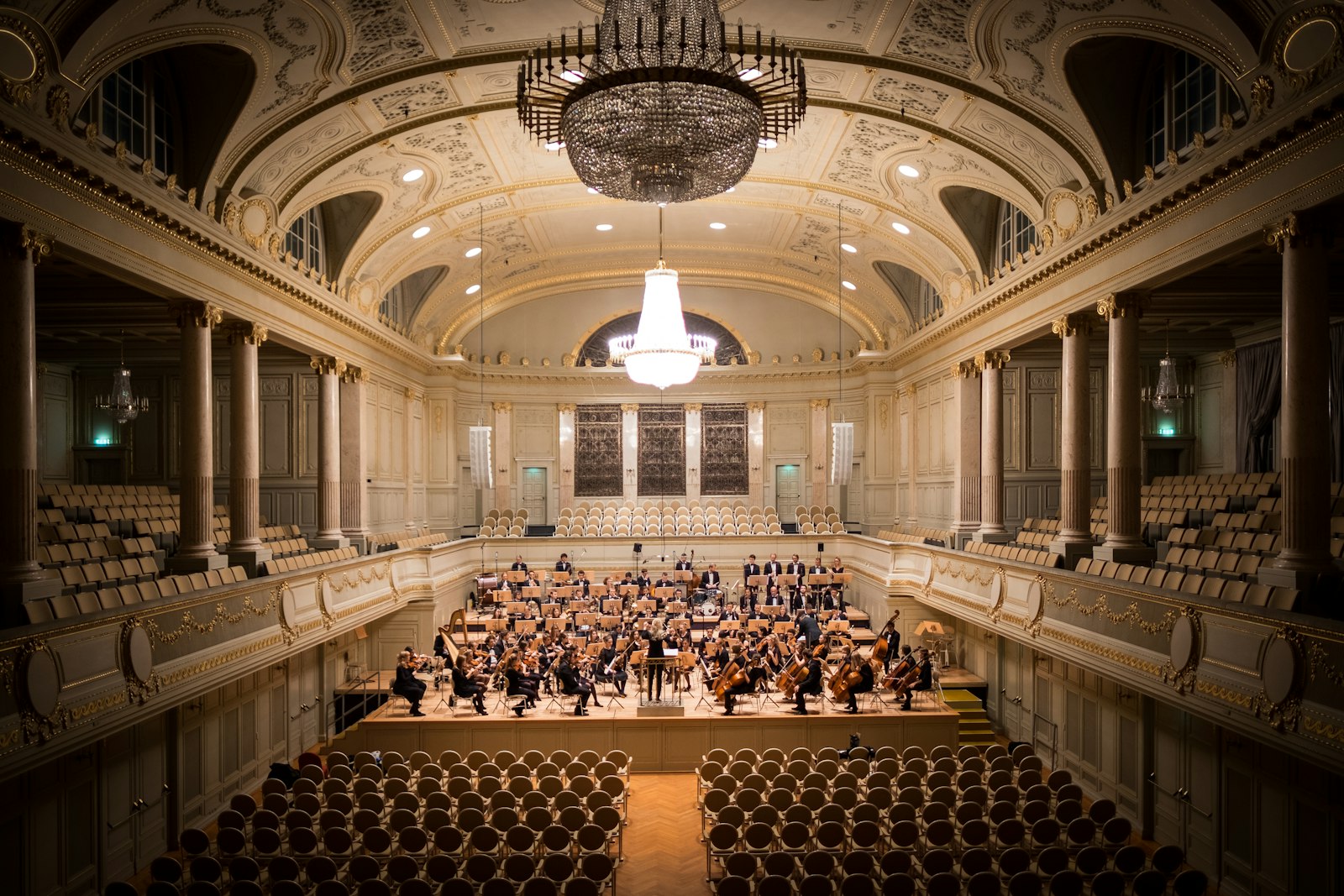
The acoustic of a yacht varies dramatically between its exterior and its interior. Outdoors, sound disperses with no reverberation, which demands real projection from the performers but, in compensation, offers exceptional clarity — particularly flattering to the Baroque repertoire and to intimate chamber music. In a saloon, the acoustic approaches that of a small recital room, with the moderate reverberation that suits a string quartet or a lyric voice especially well.
Our standing recommendation: for a musical cocktail at the close of the afternoon, choose the upper deck. For a more formal recital or a ceremony, the saloon offers conditions that are more stable and independent of the wind.
Types of yacht: motor yacht, sailing yacht, catamaran
Each yacht type has its own advantages for a musical event. The motor yacht offers more generous interior volume, perfect stability at anchor, and the capacity to carry heavier instruments such as a piano. The sailing yacht brings an unrivalled romance, particularly for a wedding ceremony or a sunset concert, though its spaces are more constrained. The catamaran combines excellent stability — invaluable for the musicians — with a generous deck area, making it often the ideal choice for a string quartet or a wind quintet.
Technical considerations to anticipate
A musical event on a yacht involves several technical questions: sufficient electrical supply (particularly where discreet amplification is foreseen), protection of the instruments against saline humidity and temperature shifts, a quiet rehearsal space for the performers, and convenient access for the transport of heavier instruments from quay to deck. An experienced team manages all of this behind the scenes, so that the guests need never suspect the complexity.
The Ideal Repertoire: From Bach to Debussy
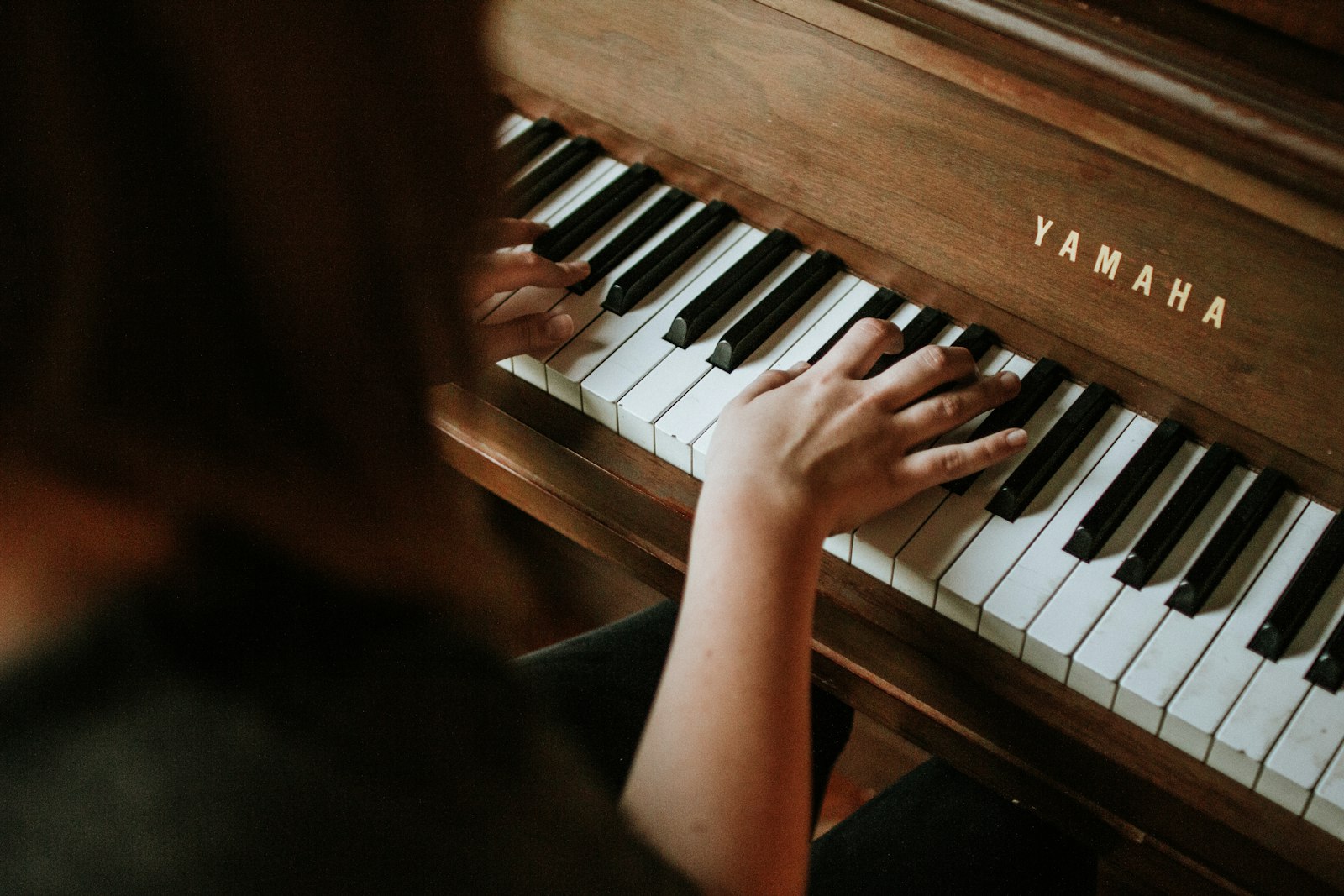
The choice of programme matters as much as the choice of performers. A well-constructed programme tells a story, makes room for breathing space, and alternates intensity with reflection. Below are the main strands to consider and what each brings to a concert at sea.
The Baroque: luminous clarity
The Baroque repertoire is particularly well suited to open-air concert. Its clear structure, its rhythmic precision and its communicative energy make it a reliably welcomed choice. Johann Sebastian Bach dominates the period with his Brandenburg Concertos, the Cello Suites, the Sonatas and Partitas for Solo Violin. Handel — composer of the Water Music itself, and a figure of immense significance to British audiences — brings his elegant solemnity. Vivaldi, with The Four Seasons, never fails to charm. And from England, Henry Purcell, the greatest English Baroque composer, offers a courtly refinement of his own — his theatre songs, his trio sonatas, his dances.
The Classical period: balance and grace
Mozart and Haydn are the pillars of this period. Their string quartets, trios and serenades — Eine kleine Nachtmusik, the Divertimenti, the great late quartets — possess a smiling elegance that marries beautifully with the Mediterranean atmosphere. Beethoven, who straddles the Classical and the Romantic, broadens the emotional palette with his sonatas and the late quartets of fathomless depth.
The Romantic: emotional depth
For the strongest moments of the evening — the ceremony of a wedding, an anniversary toast, the sunset — the Romantic repertoire offers the richest emotional palette. Chopin (nocturnes, ballades, scherzos) remains essential. Schumann, Brahms, Liszt and Mendelssohn complete the German-speaking world. The British nineteenth century is more eloquent than is often acknowledged: Edward Elgar's Salut d'Amour, his Chanson de Matin and the slow movement of his Cello Concerto carry a particular weight for English audiences.
French Impressionism: the natural companion of the sea
If any musical current seems to have been written for the Mediterranean, it is French Impressionism. Claude Debussy, in La Mer (in chamber arrangement), Reflets dans l'eau, La Cathédrale engloutie and the Préludes, translates the aquatic element into music with a precision no one has equalled. Maurice Ravel, in Une barque sur l'océan, Jeux d'eau or his chamber sonatas, prolongs the exploration. Erik Satie, with his more pared-down pages, creates a contemplative mood ideal for moments of rest.
Twentieth and twenty-first centuries: contemporary openings
For an open and curious audience, a few twentieth-century pages bring welcome freshness. Britten and Vaughan Williams for the British tradition — the latter's The Lark Ascending still polls regularly as Britain's favourite piece of classical music — Poulenc, Milhaud and Honegger for France, Schnittke and Pärt for more contemporary inflections. The classical film repertoire — Ennio Morricone, John Williams, Yann Tiersen — often makes a fine bridge between the audience and the more serious literature.
Mediterranean airs and folk arrangements
As a counterpoint to the great works, the inclusion of Mediterranean folk pieces — Spanish fandangos, Italian tarantellas, Greek traditional songs arranged for string quartet — creates charming moments of release and roots the event in its geographical setting. Such openings also make the programme more accessible to guests less familiar with the classical repertoire.
The Ideal Occasions for a Concert on a Yacht
Not every occasion calls for a musical investment of this order. The following are the contexts in which the format truly comes into its own.
A luxury wedding: the ceremony and the sunset concert
A yacht wedding in the Mediterranean is, by definition, a celebration in which every detail counts. Folding a classical recital into the day — during the ceremony, during the sunset cocktail, or at a privileged moment after dinner — gives the event an elegance that lifts it well beyond the usual standards. For the ceremony itself, Pachelbel's Canon, Bach's Jesu, Joy of Man's Desiring, Wagner's Bridal Chorus, or bespoke arrangements built around the couple's favourite pieces are among the most-requested options.
Milestone birthdays: fiftieth, sixtieth, seventieth, golden anniversaries
For the birthdays that punctuate a life — fifty, sixty, seventy, a golden wedding — a private concert at sea offers a gift that imprints itself lastingly on the family memory. Children or spouses who organise events of this kind often choose a programme built around the favourite works of the person being celebrated. It is also an occasion to gather, in regained intimacy, close family and friends, far from the constraints of a restaurant or a hired room.
A marriage proposal: the absolute moment
For those contemplating a truly exceptional proposal, a private mini-concert for two — a single violinist, or a strings-and-piano duo playing the couple's favourite piece — provides a setting of rare emotional force. The format, organised with discretion, requires careful coordination but remains accessible in budget terms.
Wedding anniversaries: renewing the vow
Ten, twenty, twenty-five, forty years of marriage: each is an occasion for a symbolic renewal of vows, whether in the precise setting of the original celebration or in a new place chosen to mark the milestone. A chamber recital, a violin-and-cello duo, or a quartet accompanies these moments with the right gravity.
Corporate hospitality and senior clients
For boards and senior management seeking to host their most strategic clients, partners or colleagues, a corporate yacht event with a classical concert is a memorable calling card. Unlike the customary gala dinner, the format speaks of a genuine cultural commitment and an attention to excellence that registers with a discerning audience. Recommended duration: a two-hour cocktail with an embedded one-hour recital, or a dinner with a musical interlude between courses.
Diplomatic and cultural receptions
Cultural institutions, embassies and private foundations find in this format an ideal frame for their more significant receptions. The European chamber music tradition is particularly well represented here and is invariably appreciated by an internationally cultured guest list.
The concert as a gift: offering the irreplaceable
To give a private concert on a yacht to a loved one — for a significant birthday, a major professional milestone, or simply as a mark of affection — is among the most powerful presents one can offer. We regularly accompany families and couples in designing this kind of gift, keeping the surprise intact until the final moment.
Thematic cruise: music day by day
For the most committed enthusiasts, a cruise of several days incorporating daily musical moments — a sunset recital each evening, listening sessions with commentary, encounters with the performers — turns the stay into a complete cultural immersion. This more ambitious format is generally built around a single composer, a period or a theme.
Plan your exceptional musical event
Wedding, milestone birthday, marriage proposal, corporate hospitality: each occasion deserves its own programme. We design your evening end to end, from the choice of yacht to the menu and the repertoire.
Acoustics at Sea: A Technical Challenge
To address the question of acoustics at sea is to enter the heart of the craft of a successful musical event. The beauty of the setting is not enough on its own: if the sound does not carry, the experience turns into silent theatre. Here are the key considerations.
Sound without reverberation
Outdoors, on the water, there is no reflecting surface to return the sound to the listener. This total absence of reverberation, contrary to first instincts, is not a defect. It demands real mastery and considerable projection from the performers, but offers in return an exceptional clarity: every note is heard distinctly, without blurring. Baroque music, intimate chamber music and solo performance find a privileged setting here.
Wind, swell, distance from shore
Weather is the principal variable to anticipate. Any wind above fifteen knots makes an open-air concert problematic: the scores will fly, the sound will scatter, the listening will become uncomfortable. Our coordinators therefore monitor the forecasts for several days ahead of the event and always propose a fallback: a move into the saloon, a shift of timing, or relocation to a more sheltered cove. The choice of day is equally crucial: we favour calmer conditions, generally in late afternoon and early evening, when the Mediterranean breeze drops.
Discreet amplification: yes, but how?
For lighter formations — solo, duo — and for voice, discreet sound reinforcement may be necessary once the audience exceeds twenty. The principle is straightforward: high-grade directional microphones, carefully positioned speakers, and a sound engineer on hand to adjust in real time. The aim is never to amplify, but simply to ensure that every guest — even one seated ten metres from the players — hears the music properly. For a string quartet or a larger ensemble outdoors, the natural acoustic is generally sufficient.
The golden hour
Between 6 p.m. and 8.30 p.m. in high summer, the Mediterranean light reaches its peak, the wind generally drops, and the temperature remains agreeable. This is what photographers call the golden hour, and it is also the chosen moment for a private classical recital at sea. Our recommendation for a ninety-minute event: begin at 6.30 p.m. with a musical cocktail at sunset, move into the main recital towards 7.15 p.m., and close with a twilight toast around 8.45 p.m.
Leading Mediterranean Destinations
The western Mediterranean offers a remarkable range of settings for a concert on a yacht. Below are the destinations we most often recommend, each with its own particular atmosphere.
Valencia and the Valencian coast: our home port
Our base in Valencia is an ideal point of departure for musical events along the Spanish Mediterranean coast. The Valencia marina offers modern facilities suited to yachts of all sizes, and the surrounding coastline is rich in privileged anchorages. The Albufera natural park, just south of the city, offers sunsets of singular beauty over its lagoon. The coves of the southern Valencian coast provide wilder, more secluded settings, ideal for events seeking real intimacy.
Valencia's strategic advantages for an international clientele are considerable. The city is served by direct flights from London (Heathrow, Gatwick, Stansted, Luton), Manchester, Edinburgh and Dublin, as well as from major hubs across Northern Europe and the United States via Madrid. Overall costs are notably lower than on the French Riviera or in the Balearics in season, and our team is fluent in English. It is our destination of choice for weddings, milestone birthdays and corporate events.
The Balearics: Ibiza, Mallorca, Formentera
Within a few hours' sailing from Valencia, the Balearic Islands form one of the most prestigious yachting playgrounds in the western Mediterranean. Ibiza offers the legendary sunsets — Cala Salada, Es Vedrà — that lend themselves admirably to a concert at dusk. Mallorca, with bays such as Cala Mondragó, Cala Deià and Port de Sóller, offers a more reflective, more cultivated setting. Formentera, the smallest and quietest of the islands, offers absolute privacy for the most exclusive events.
For UK and European visitors, the Balearics are unusually accessible: a two-hour flight from London or three hours from most Northern European capitals, followed by a short transfer to the marina. For a substantial musical weekend, the combination of Valencia, Ibiza and Formentera over three or four days is one of our most-requested formats.
Costa Brava and Barcelona
Further north, the Costa Brava and Barcelona offer an exceptional cultural setting, immediately accessible from across Europe. The coves of Cadaqués, Cap de Creus and Tossa de Mar lend themselves to intimate concerts, while Barcelona allows the musical event to be combined with cultural visits (the Sagrada Família, the Palau de la Música, the Liceu opera house).
The French Riviera: an adjacent context
Although our operational base is in Valencia, the French Riviera remains a reference for musical events at sea, and many of our clients pair a Spanish charter with a visit to its great festivals. Cannes, Nice, Saint-Tropez and the bay of Villefranche-sur-Mer have hosted the European elite for cultural seasons since the nineteenth century. For clients combining a stay on the Riviera with a Mediterranean charter, we coordinate also along this coast.
The Culinary Dimension: When Cuisine Meets Music
On a yacht, music is not separated from the table. Designing a dinner or a cocktail in dialogue with the musical programme adds a further sensory dimension to the experience.
Matching the menu to the repertoire
This approach, inherited from the great cultural evenings of European tradition, consists in choosing dishes and wines in keeping with the musical atmosphere. For a Baroque or Classical programme, a refined classical kitchen — fine starter, noble fish, well-aged cheeses, classical dessert — creates a coherent unity. For an Impressionist programme (Debussy, Ravel), a more modern, more creative kitchen, playing on textures and subtle flavour notes, prolongs the musical aesthetic naturally. For a German Romantic programme (Brahms, Schumann), a richer, more warming cuisine sits admirably alongside.
Wines and champagnes: the sommelier's role
An experienced sommelier on board is one of the secrets of a perfectly orchestrated evening. Precise pairings are proposed for each dish and each musical moment: Blanc de Blancs champagnes for the opening cocktail, mineral whites from Galicia or Puglia for the fish courses, Rioja or claret for the main course, sweet wines or rosé champagnes alongside the dessert and the closing music. On request, fine wines from a particular region — Burgundy, the Mosel, Sherry country — can be embarked specially for the evening.
The tempo of the evening
A successful musical evening keeps to a careful tempo: a twenty-minute musical cocktail for the reception, dinner with a musical interlude (or a full recital after the meal), a toast and a closing musical moment at sunset or as night falls. An experienced coordinator ensures the fluidity of every transition, synchronising kitchen, service and musicians.
A chef on board: the starred dimension
For the most prestigious events, the embarkation of a starred chef — Michelin-decorated or otherwise widely recognised — adds a further dimension to the evening. We work regularly with several leading chefs along the Spanish and French coasts, who compose bespoke menus aligned with your musical programme, your budget and your preferences.
How to Organise: The Process from A to Z
Designing a musical event on a yacht requires several months of planning for the most ambitious occasions, and a few weeks for the simpler ones. The principal steps are as follows.
1. Define the frame
The first step is to set the date, the number of guests, the overall budget, the occasion to be celebrated and the atmosphere sought. At this stage, a first conversation with our concierge allows the major choices to be oriented quickly.
2. Choose the destination and the yacht
According to your point of departure, the intended duration and the number of guests, we propose two or three yachts that fit. A virtual visit — or, for the more significant events, a physical inspection of the yacht — is arranged before the contract is signed.
3. Select the musical ensemble
The choice of performers is one of the most essential decisions. We work with a network of professional musicians — quartets, pianists, harpists, lyric singers — selected for their quality and their experience in event contexts. Recordings can be listened to in advance, and for the most important events the artists can be met before the engagement.
4. Build the programme
Once the musicians are chosen, the programme is constructed in dialogue with them. This phase is the moment to share your preferences, your musical memories, the works that have marked your own or your family's story. The final programme, usually an hour to ninety minutes long, alternates familiar works with discoveries.
5. Coordinate with the kitchen
The menu, the wines and the service are designed in parallel, in coherence with the musical programme. This stage involves the chef on board, the sommelier and the maître d'hôtel.
6. Logistics: transfers, accommodation
For guests travelling from further afield, we arrange airport transfers, accommodation in Valencia or the Balearics, and the full logistics of the day itself. The musicians are provided with a discreet rehearsal space and appropriate dressing rooms.
7. Technical rehearsal
The day before, or on the morning of the event, a technical rehearsal on board allows the placement of performers to be finalised, the sound to be tested where necessary, and coordination with the crew to be locked down. This invisible step is what ensures that everything unfolds without a hitch.
8. The day itself
The event itself follows a precisely timed running order: reception at the marina, embarkation, navigation to the anchorage, musical cocktail, dinner and recital, sunset toast, return to harbour. Every transition is anticipated, every moment carefully orchestrated. Your only concern is to enjoy the evening.
Cost and Investment
The question of budget naturally arises in early conversations. Below are indicative orders of magnitude for a musical event on a yacht in the Mediterranean, excluding any specific bespoke requirements.
Intimate concert (up to twelve guests)
For a yacht of eighteen to twenty-two metres, a duo or trio formation, a refined dinner for twelve, a half-day with sunset: from EUR 4,500 all-inclusive. The format suits a marriage proposal, an anniversary or an intimate birthday.
Mid-scale concert (twenty to forty guests)
For a yacht of twenty-five to thirty-five metres, a string quartet or quintet, a refined dining cocktail and a complete evening: from EUR 9,500 all-inclusive. Suitable for a civil wedding, a milestone birthday or a senior corporate event.
Prestige event (forty to eighty guests, yacht 35–50 m)
For a superyacht, a chamber ensemble or sextet, a gastronomic dinner with a starred chef and a full-day cruise: from EUR 22,000 all-inclusive. The format suits major celebrations (golden weddings, important family anniversaries), grand weddings and strategic corporate receptions.
Musical cruise (several days)
For thematic cruises of two to five days, prices are studied bespoke according to the itinerary, the musical complement on board and the additional services (cultural excursions, tastings, masterclasses). A musical weekend of three days for twelve to twenty guests starts from EUR 35,000.
A comparison worth pondering
For a unique experience that mobilises yacht, musicians, chef, sommelier, crew, transfers and full coordination, the value-for-money compares favourably with an equivalent reception in a stately home or a prestige venue — particularly since maritime elegance is not rented at the price of decoration: it is offered, freely, by the sea itself.
Frequently Asked Questions
How can good acoustics at sea be guaranteed?
Three levers: the choice of an anchorage sheltered from the wind, the selection of a musical formation whose natural projection suits the setting, and — where necessary — discreet sound reinforcement handled by a professional sound engineer. A move into the saloon is always planned as a back-up in case of wind.
How many musicians can be accommodated?
From one (solo recital) to twelve (chamber ensemble), depending on the size of the yacht. The majority of engagements involve formations of two to six musicians, comfortably accommodated aboard yachts of twenty-two to thirty-five metres.
What are the recommended booking lead times?
For high season (June to September), three to six months ahead is advisable. For prestige events involving a starred chef or internationally recognised performers, count on six to nine months. Out of season (April, May, October), engagements can be arranged with four to six weeks' notice.
What happens in bad weather?
Our team monitors the forecast for several days ahead of the event. Should the weather turn: a move into the main saloon of the yacht, relocation to a sheltered cove, or — in the last resort — a postponement. A specific clause in the contract covers this point.
Can the concert be recorded?
Yes, a professional audio recording (or video) can be arranged as an option. It is an especially treasured memento — particularly for weddings, significant birthdays or marriage proposals. Any public-use rights for the recording are agreed in advance with the musicians.
Do the musicians speak English?
All our musicians speak English to a working standard, and our concierge is fluent. For events where direct communication with the artists matters (presenting the works, conversing with guests, post-concert hospitality), we specifically select performers comfortable in English.
What is the typical budget for an event for thirty people?
For around thirty guests, a yacht of twenty-seven to thirty-two metres, a string quartet, a complete dining cocktail across an evening of four to five hours: the budget generally falls between EUR 11,000 and EUR 16,000, depending on the gastronomic level chosen.
Can the event be combined with other cultural activities?
Indeed. A private visit to the Sagrada Família or the Palau de la Música in Barcelona, a wine tasting in the Valencia region, a visit to artists' studios in the Balearics, a private masterclass with a musician: we regularly design programmes that weave the concert at sea together with cultural discoveries ashore.
A Living Tradition, Yours to Write
To organise a classical concert on a private yacht in the Mediterranean is to place your personal event within a European tradition reaching back several centuries. It is also, for your guests, to offer one of those complete sensory experiences — visual, auditory, gastronomic, emotional — that imprint themselves lastingly on memory. Whether you are celebrating a wedding, an anniversary, a strategic encounter, or simply wishing to give the irreplaceable, this format unites maritime elegance, European heritage and absolute privacy in a single evening.
The success of such a project rests on careful guidance, a network of confirmed performers, an informed knowledge of yachts and anchorages, and a constant attention to detail. Our team in Valencia is dedicated exclusively to this craft of bespoke event design. We would be honoured to design with you your own exceptional musical evening.
Let us design your exceptional concert together
Tell us about your project. Within 24 hours, our concierge will propose a first programme tailored to your event, your budget and your musical taste. With no obligation.