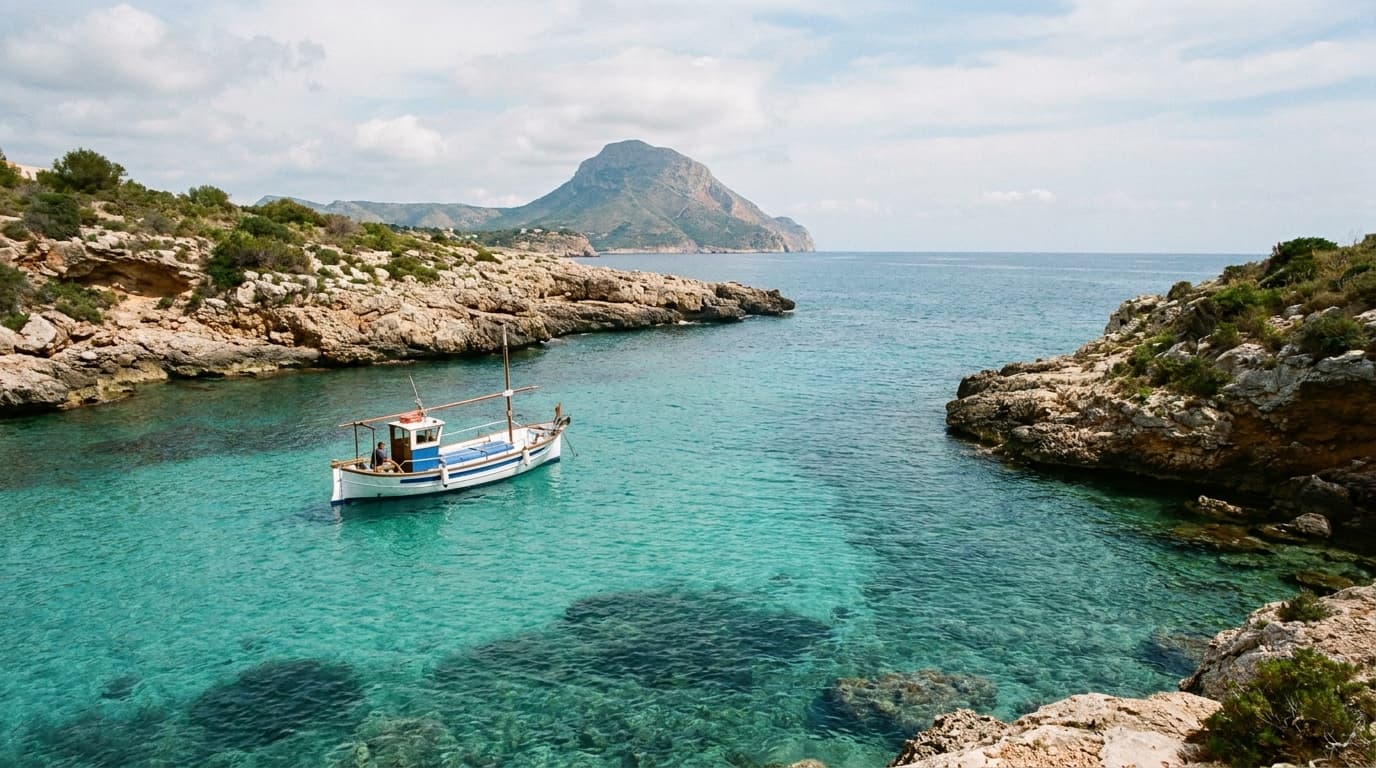
If you drew a line across the Costa Blanca with Benidorm's high-rises and foam parties at one end, Javea — Xàbia in Valencian — would sit at the very far end of it. There is no strip, no skyline, no queue of party boats blasting competing playlists across the bay. What there is instead: a 753-metre mountain rising straight out of the coastal plain, two rocky capes that bracket the town like bookends, water clear enough to read the seabed at ten metres, and a string of coves that look better from a boat deck than from anywhere on land.
That makes Javea one of the most rewarding places on this coast to take a boat out — and also one of the easiest to get slightly wrong if you arrive expecting something it is not. This guide covers what we tell our own guests before a boat rental in Javea: how the coast is laid out, what kind of boat suits what kind of day, the rules that genuinely apply on the water (and one that doesn't, despite what you may read elsewhere), and how to plan around the town's one honest quirk — its sunsets.
The Lie of the Land
Javea's geography does most of the work for you. The town sits in a wide bay facing east, sheltered on its northern side by the Montgó massif, which drops to the sea at the Cap de Sant Antoni, and closed off to the south by the Cap de la Nau — the easternmost point of the whole Valencian coast. Between the two capes lies everything you need for a day afloat: the fishing port and Club Náutico below the northern headland, the gravel beach of La Grava beside it, the long sandy sweep of the Arenal in the middle of the bay, and then a succession of rocky points and coves running south towards Granadella.
The practical consequence is that you are never far from anything. Most of the coves people charter a boat to reach — Portitxol, Sardinera, Ambolo, Granadella — sit within a few nautical miles of the port. There is no long delivery passage, no hour of motoring before the good part starts. You cast off, round a headland, and the scenery begins.
One note on the harbour itself: Javea's Club Náutico is a compact, working marina rather than a superyacht showcase — it accepts vessels up to 25 metres in length and not beyond. If your ambitions run larger than that, base yourself in Denia and make Javea a destination. For everyone else, the modest scale of the port is part of the charm. This is a town where the fishing fleet still comes in and the boat traffic stays human.
Choosing the Right Boat
What you hire should follow from what you actually want the day to be, and Javea rewards several very different answers.
Licence-free boats. Under Spanish regulations, small motorboats — up to six metres in length with engines up to 15 hp — can be hired without a nautical licence, for daytime use within two nautical miles of a harbour or refuge. In most places that restriction is frustrating. In Javea it is barely a restriction at all, because so much of the good coastline sits inside that radius. A licence-free boat will comfortably take you from the port to the Portitxol area and back with time to swim, and it is the cheapest way to get a family onto this water.
Skippered motorboats and RIBs. The sensible default for most visitors. A local skipper knows which cove is sheltered from today's wind, where the seagrass lies, and when Granadella is worth visiting versus when it is a car park of hulls. You do nothing but swim, eat and look at cliffs.
Sailing yachts and catamarans. The distances here are short for a sailing day, but that is precisely what makes a lazy one work: short hops, long anchorages, plenty of swimming. A catamaran's stability and deck space suit groups and families; a monohull suits people who actually want to sail. For either, a full-day yacht charter in Javea lets you string three or four coves together without ever hurrying.
The Rules That Actually Apply — and One That Doesn't
Spanish coastal waters are governed by rules that are simple enough once someone states them plainly, so here they are.
Speed near the shore. Under Spain's state coastal regulations (Royal Decree 876/2014), vessels must keep to 3 knots within 200 metres of a beach, and within 50 metres of the rest of the coastline. That is a national rule, not a local Javea invention, and it applies everywhere on this coast. Separately, Javea marks its busiest swimming beaches with buoyed zones and access channels in summer, with the same 3-knot discipline near them — treat the yellow buoys as a hard boundary, because that is exactly what they are.
Swimmers come first. Anchoring inside buoyed bathing zones is prohibited. Drop your hook outside the buoys and swim in; it costs you fifty metres of swimming and saves you a fine and, more to the point, keeps propellers away from children.
The marine reserve myth. The waters around the Cap de Sant Antoni are a protected marine reserve, and you will sometimes see it written that the reserve imposes its own special speed limit on pleasure boats. It does not — the regional decree establishing the reserve contains no such limit. What applies there is what applies everywhere else: the state near-shore speed rules above, plus the reserve's protections for the seabed and marine life. Slow down near the cliffs anyway, because the snorkelling is the whole point, but slow down for the right reason.
Posidonia — the rule that is genuinely new. Since April 2026, Spanish law (Royal Decree 191/2026) prohibits anchoring over posidonia seagrass meadows, and the prohibition extends to adjacent sand where a boat's swing circle would drag chain across the meadow. Posidonia is the reason Javea's water looks the way it does — the meadows filter and oxygenate it — and an anchor chain sweeping through one does decades of damage in an afternoon. In practice: anchor on clearly visible sand, give yourself honest swing room, and if you cannot tell what is under you, move until you can. A skippered boat makes this someone else's expertise entirely.
Where the Days Actually Go
The classic Javea boat day runs south. From the port you pass the Arenal, round the Cap Prim into the Portitxol bay with its island and its white-crossed chapel views, continue past the Cap Negre to Ambolo and the Isla del Descubridor, and finish — conditions and crowds permitting — at Granadella, the famous pine-backed pebble cove near the Cap de la Nau. Done slowly, with two or three swim stops, that is a full and very good day.
The northern alternative is shorter but wilder: along the base of the Cap de Sant Antoni cliffs, below the lighthouse, where the Montgó meets the sea and the rock faces glow amber in the morning light. This is reserve water — pristine, fishy, and best treated gently.
Group celebrations work differently here than further south, and honestly better for it. A boat party in Javea means your own boat, your own music at a volume the next cove cannot hear, swimming in clear water and food that isn't served in a plastic bucket. If your group wants a floating nightclub, Javea is the wrong town — and that is precisely why certain groups choose it.
The Sunset Question, Answered Honestly
Here is the thing most sunset-cruise marketing on this coast will not tell you: in Javea, the sun does not set over the sea. The town faces east, and the sun goes down behind the Montgó — in high summer it slips behind the mountain's shoulder without you ever seeing it touch a horizon.
What you get instead is arguably better, and it is what an evening sunset cruise in Javea is actually selling: the afterglow. The light softens, the sea turns to pewter and rose, and the limestone of the Cap de Sant Antoni and the whole Montgó massif catch the last direct sun and turn gold while you watch from the water with a glass of something cold. It is a quieter spectacle than a blazing horizon, and it suits the town. Just come knowing what the show is.
When to Come
The season runs roughly May to October. June and September are the local's answer: warm sea, settled weather, empty coves midweek. July and August bring the warmest water and the most company — Granadella in particular fills early, so go first thing or save it for a September visit. May and October are gambles that often pay off handsomely, with the proviso that you watch the forecast and stay flexible about which side of the bay you use.
Whatever the month, mornings are Javea's best hours on the water: light wind, glassy coves, and the east-facing coast lit straight-on by the rising sun. Start early, anchor often, and let the quietest town on the Costa Blanca do what it does best — which is very little, very beautifully.