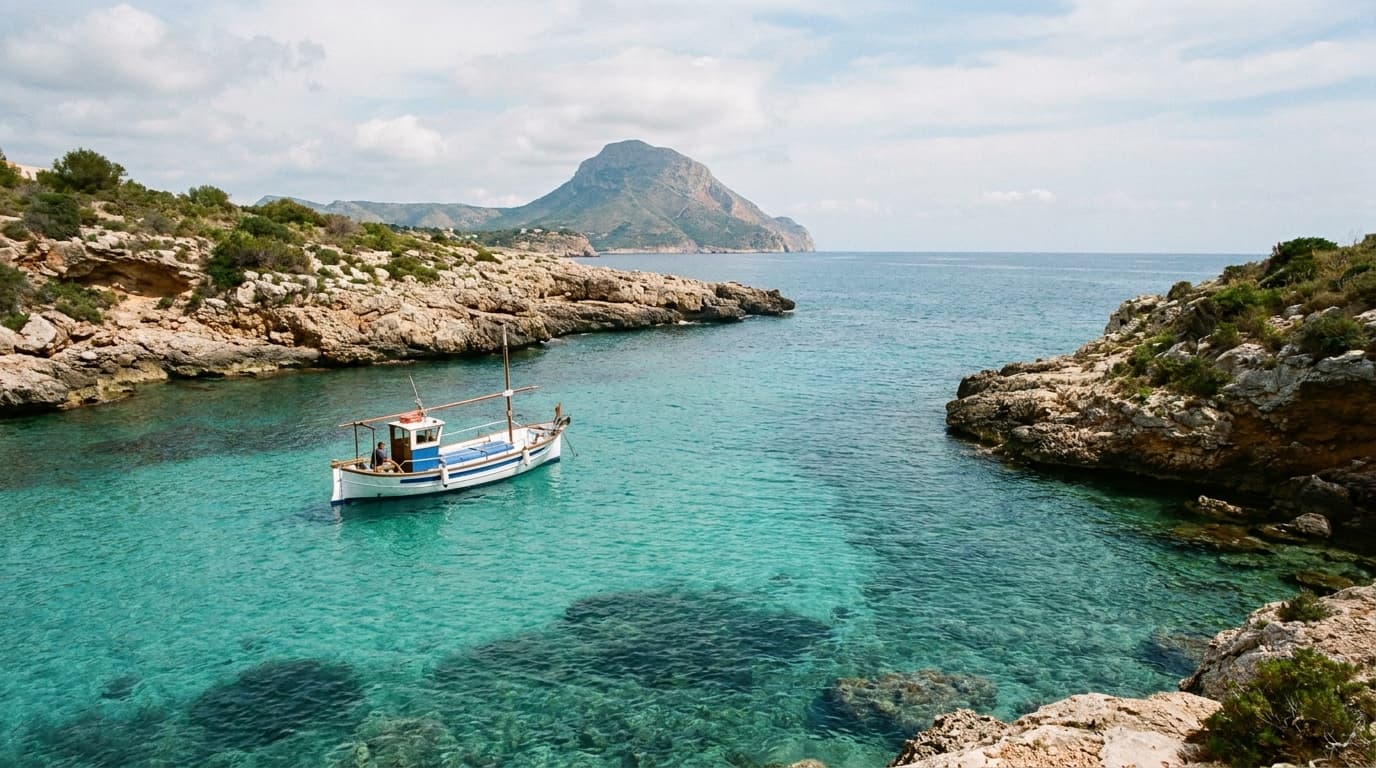
Javea does not really do beaches in the usual Spanish sense. It has one proper sandy one — the Arenal, in the middle of the bay — and then it stops apologising and gets on with what it actually does, which is coves. Pebble coves under pine cliffs, white tosca-stone coves, coves with islands parked photogenically offshore, coves you cannot reach by land at all. Strung between the Cap de Sant Antoni in the north and the Cap de la Nau in the south, they form one of the best short cruising grounds on the Costa Blanca — and the whole string fits inside a single unhurried day on the water.
This is our cove-by-cove guide, written the way we brief guests before a boat rental in Javea: what each spot is, what it is like from the water, and the honest practicalities — including where you can and cannot put an anchor down.
First, the Two Rules Worth Knowing
Two pieces of regulation shape every anchoring decision on this coast, so let us deal with them up front. First, Spain's state coastal rules (Royal Decree 876/2014) require 3 knots within 200 metres of any beach and within 50 metres of the rest of the shore, and forbid anchoring inside the buoyed swimming zones that Javea lays out in summer. Second — and newer — since April 2026, Royal Decree 191/2026 prohibits anchoring over posidonia seagrass meadows, and the ban extends onto neighbouring sand where a swinging boat would sweep its chain across the meadow. The posidonia is why this water is so clear; the rule has teeth and deserves them. The working method in every cove below is the same: find clean, clearly visible sand, allow honest swing room, and if in doubt, move.
One thing you will not find here is a special marine-reserve speed limit around the Cap de Sant Antoni. Despite what gets repeated online, the decree establishing the reserve sets no such limit — the near-shore speed rules above are what apply, there and everywhere else.
Cala de la Granadella
The famous one. A pebble cove of some two hundred metres tucked into the coast near the Cap de la Nau, closed in by pine-covered slopes, with water that shifts from pale jade over the shallows to deep blue-green in the middle. Granadella has won national best-beach reader polls more than once, and while we would never call any beach the best in Spain as though that were a measurable fact, we understand why people vote for it. From the water it is at its most persuasive: you arrive round the headland and the whole amphitheatre opens at once.
From the water: the cove faces east and is easy to read on approach. In July and August it fills — with swimmers from the road side and boats from yours — so come at nine in the morning or come in June or September. Anchor outside the buoyed swim zone on sand, watch for the darker patches that mean seagrass or rock, and dinghy or swim in. The snorkelling along both rocky arms of the cove is some of the best in the area, with octopus, wrasse and the occasional barracuda school around the points.
Cala Ambolo and the Isla del Descubridor
Ambolo is the cove that makes the strongest argument for arriving by sea, for the simple reason that arriving by land is not really an option: the access has been officially closed for years owing to rockfall risk from the unstable cliffs above. The result is a steep, wild, near-empty cove in one of the busiest months of the Spanish summer — a genuine rarity.
From the water: just offshore sits the Isla del Descubridor, a bare, rocky islet whose channel and surrounding reefs make a superb snorkelling circuit in calm weather. The seabed shelves quickly and mixes rock, sand and seagrass, so this is a spot where you pick your sand patch deliberately rather than dropping the hook on arrival. Settled conditions only; there is no shelter here when the easterly builds. Treat it as a swim stop rather than a lunch-long anchorage and it will be a highlight of the day.
Cala Sardinera
A quiet pebble cove on the north side of the Cap Prim headland, reachable on foot only by a hot, stony footpath — which is exactly why it stays quiet. There are no facilities, no bar, no sunbeds: just pale stones, clear water and pines. Boats have the enormous advantage here, arriving cool and carrying their own shade and lunch.
From the water: Sardinera works best as a morning stop before the Portitxol bay next door gets going. Sand patches sit among rock and seagrass close in; take a moment to read the bottom before anchoring, and keep outside any seasonal swim buoys. On a weekday in June you may well have the place to yourselves, which on this coast in this century feels almost illicit.
Portitxol and Cala Barraca
Round the Cap Prim and you enter the postcard: the wide Portitxol bay, with the flat-topped Illa del Portitxol anchored in the middle of it and the pebble beach of Cala Barraca — white fishermen's cottages, blue doors — at its back. This is probably the most photographed corner of Javea, and unusually, the reality outdoes the photographs, because the photographs cannot show you the water clarity from a deck three metres above it.
From the water: the bay offers the most generous anchoring in the area, with good sand in the channel between island and shore — but it also holds healthy posidonia, so this is precisely where the seagrass rule earns its keep. Anchor only where you can see clean sand under you, and give the meadow margins a wide berth with your swing circle. The island itself makes a wonderful slow lap by boat or paddleboard, and the snorkelling around its fringes is rich and easy. Cala Barraca has a small seasonal beach restaurant; cash and patience both recommended in August.
Cala Blanca
Just south of the Arenal, the coast turns briefly white: a pocket of small coves cut into pale tosca stone, more a chain of swimming spots than a beach. Locals swim here off the rocks all summer; from a boat it is a lovely, low-effort stop — clear shallow water over bright stone that turns the sea an improbable milky turquoise on sunny days.
From the water: stay well outside the swimmers and the buoyed zones, keep to the 3-knot discipline close in, and treat it as a swim-and-move stop rather than an anchorage. It slots naturally between the Arenal and the Cap Prim on your way south.
The Cap de Sant Antoni and the Cova Tallada
North of the port, everything changes register. The Montgó massif meets the sea in cliffs at the Cap de Sant Antoni, the water below them lies within a protected marine reserve, and the coast stops being about beaches altogether. This is the wild end of the day: amber rock faces, deep clear water, fish life that shows what four decades of protection do.
From the water: at the base of the cliffs on the Denia side hides the Cova Tallada — a sea cave that is part natural, part hand-quarried, its walls carved centuries ago by workers cutting tosca stone. It is a remarkable place, and a regulated one: in high season access is restricted and numbers are capped, so check the current rules before you plan on swimming in rather than admiring the entrance from the water. Throughout the reserve, go slowly, anchor nowhere near seagrass, and let the snorkelling — which is the best in Javea — reward the restraint.
Putting the Day Together
The classic full-day run works south to north or north to south, but the coves have opinions about timing. Granadella and Ambolo want the morning, before the crowds and the afternoon breeze; Portitxol handles the middle of the day with grace and feeds you; the Cap de Sant Antoni cliffs are at their theatrical best in the low evening light, when the Montgó catches the last sun and turns gold above you — which, since Javea's sun sets behind the mountain rather than over the sea, is the honest version of a sunset cruise in Javea, and a beautiful one.
You can do the whole string with a skippered day boat, or take a full-day yacht charter in Javea and let the coves set the rhythm: anchor, swim, eat, repeat, with the Montgó keeping watch over all of it. Six coves, five miles of coast, one quietly spectacular day.