There are landmarks you photograph and landmarks that rearrange your sense of scale. The Peñón de Ifach belongs firmly to the second category. From the promenade in Calpe it is impressive enough — a 332-metre wedge of limestone rearing above the marina, the sort of thing you assume must be an island until you notice the town tucked against its base. But it is only from the water that the Peñón makes complete sense. Drift beneath its seaward face in a small boat, cut the engine, and let your eyes travel up three hundred metres of sheer, sun-baked rock, and you understand why this is the single most recognisable silhouette on the Costa Blanca.
We have taken guests around the Peñón in every month of the season, in everything from small self-drive boats to fully crewed yachts, and it never loses its effect. This guide covers what the rock actually is, why the view from the sea beats the view from the summit, where to swim in its shadow, and — because we would rather be straight with you than sell you a postcard that does not exist — exactly what the light does here in the evening.
What Exactly Is the Peñón de Ifach?
The Peñón de Ifach is a massive limestone outcrop rising 332 metres straight out of the Mediterranean beside Calpe, joined to the town by a low, narrow neck of land. It is protected as a natural park — the Parque Natural del Peñón de Ifach — and it is one of the smallest natural parks in the Valencia region, which tells you something: the rock itself is the entire point. There is no sprawling hinterland, no buffer of forest. Just the great stone tooth, the sea around it, and the plants and seabirds that have made a home on ledges no human will ever stand on.
Seen from a boat, the scale becomes physical rather than theoretical. The cliffs on the seaward side drop into deep blue water with barely an apron of rock at their feet. Gulls and other seabirds wheel off the upper ledges, appearing and vanishing against the pale stone. On calm mornings the sea at the base is glassy enough that the rock appears twice — once above the waterline and once, wavering, below it.
Why the Sea View Beats the Summit
Plenty of visitors hike the Peñón, and the summit path is a famous outing in its own right. But there is an obvious catch that nobody mentions: when you are standing on the rock, you cannot see the rock. The best view of Calpe's defining landmark is, by definition, unavailable to the people on top of it.
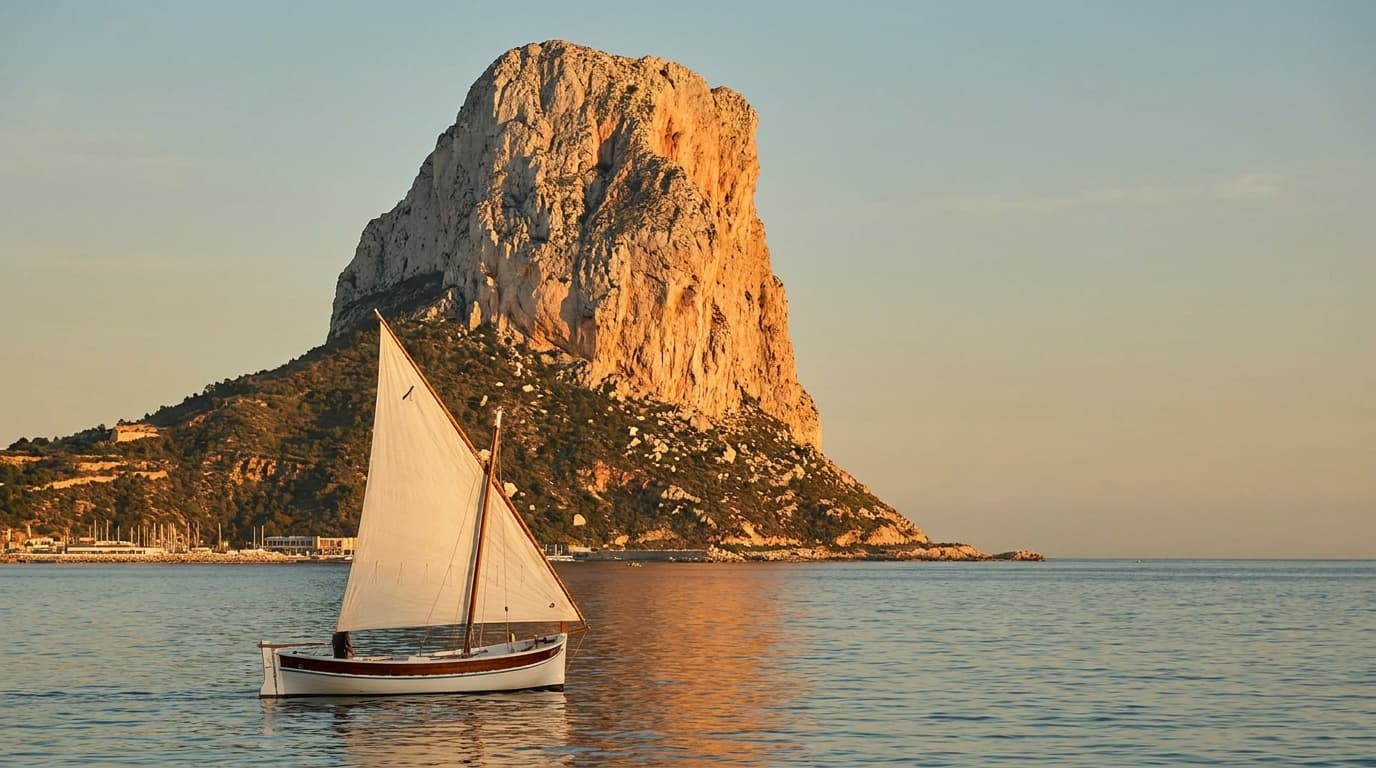
From the water, you get the whole composition at once — the sheer profile, the town curled around its base, the long pale arcs of the beaches on either side, and behind everything the grey-blue wall of the Sierra de Bernia inland. You also get angles that simply do not exist from land. The seaward face of the Peñón is invisible from the town; the only way to see it is to go around by boat. Rounding the headland and watching the familiar postcard profile rotate into something wilder and steeper is, for our money, the best fifteen minutes on this stretch of coast.
Rounding the Rock: The Seaward Face
A typical circuit takes you out of the marina, along the base of the north side, around the seaward tip and back along the southern flank. Going slowly is not a compromise here — it is the entire point. The texture of the cliff changes constantly: smooth pale slabs, orange-stained overhangs, bands of scrub clinging to impossible ledges. Skippers who know the rock will position you where the cliff towers most dramatically overhead and then simply let the boat sit for a while, which is when cameras come out and conversations tend to stop.
Keep an eye on the water as well as the cliff. The sea around the Peñón is clear and, close to the rock, alive: shoals of small silver fish flickering around the boulders, and the darker outlines of larger fish patrolling below. If your boat carries snorkelling gear, the rocky margins at the base of the Peñón and around Cala del Racó — the small cove tucked against the rock beside the marina — are the natural place to use it.
Swimming in the Shadow of the Peñón
Anchoring off for a swim is the classic mid-point of any Peñón trip. The water here has that particular Mediterranean clarity that makes depth hard to judge — you can watch your own shadow on the seabed and the light ripple across it. Floating on your back with three hundred metres of limestone filling half the sky is a strange, wonderful sensation; the rock feels closer than it is, and the ordinary noise of the coast — traffic, music, other people — simply is not there.
Two honest notes. First, this is a popular stretch of water in July and August, and on peak weekends you will share it; mornings are noticeably quieter and the light on the rock is lovely then too. Second, the rules that govern where and how boats move near swimmers are not optional, and we cover them below, because a good day here depends on everyone respecting them.
Golden Hour at the Peñón: The Honest Version
Here is something most brochures will not tell you, and it matters if an evening trip is on your list. Calpe does not do horizon sunsets. The coast here faces east and south-east, and inland stands the Sierra de Bernia, a ridge rising to 1,128 metres. The sun drops behind that ridge roughly forty minutes before the time printed in the almanac — and no, motoring further out to sea does not change it, because the mountain is behind you whichever way you point the bow.
So if anyone promises you a blazing sun melting into the Mediterranean, be sceptical. What Calpe offers instead is, in our view, better and far less common: because the Peñón faces away from the setting sun, its great seaward wall is lit from the front in the final hour of direct light. The whole rock ignites — first gold, then a deep, improbable orange — while the sea beneath it turns to slate and silver. You are not watching the sun; you are watching what the sun does to three hundred metres of limestone. It photographs beautifully and it feels like a secret, because most people are looking the wrong way.
The practical rule: be on the water by around 19:30 to 20:00 in high summer, not at the published sunset time. Arrive at the almanac hour and the show is already over — the mountain has taken the light. Our golden-hour cruises are timed around the mountain, not the almanac, for exactly this reason.
The Rules of the Water Here
Spanish state law — not local whim — governs how boats behave near the shore, and it is worth knowing the essentials before you take the helm yourself. Under Royal Decree 876/2014 (Article 73), vessels must keep their speed to 3 knots within 200 metres of beaches, and within 50 metres of the rest of the coast. Anchoring inside buoyed swimming zones is prohibited outright. These rules apply along the entire Spanish coastline, Calpe included, and around a landmark that draws swimmers, snorkellers, paddleboarders and kayaks all summer, they are simple common sense as much as law.
Beyond the letter of the law: give swimmers a wide margin, take your rubbish home, and avoid dropping anchor on dark patches of seabed, which are usually posidonia seagrass meadows — slow-growing, ecologically precious, and easily damaged. Sand shows as pale turquoise; aim for that.
Practical Tips
When to go: The season runs comfortably from May to October. Mornings offer the calmest water for the circuit of the rock; late afternoon into golden hour offers the famous light. June and September are the connoisseur's months — warm sea, softer light, fewer boats.
What to bring: Sunscreen, a hat that will not blow away, water, a swimsuit and towel, and a camera with more storage than you think you need. Wind at sea is deceptive — a light layer for the trip back after sunset is never a mistake.
Sea state: The Peñón itself shelters the water near Calpe in many conditions, but if a swell is running, the seaward face is best admired from a respectful distance. A good skipper will make that call for you.
How to See It
There are three straightforward ways to put yourself under the rock. Join one of our scheduled boat excursions from Calpe, which build the full circuit of the Peñón and a swimming stop into a relaxed outing. Take the helm yourself with a boat rental in Calpe — the rock is minutes from the marina, which makes this one of the most rewarding short self-drive trips anywhere on the coast. Or, for a longer day with the decision-making handed to someone else, a private yacht charter pairs the Peñón with the quiet coves up and down the coast, cava in the fridge and nowhere to be by any particular time.
However you do it, do it from the water at least once. The Peñón de Ifach has been photographed millions of times from the beach. From a boat drifting at its feet, it stops being a postcard and becomes a presence — and that is a different thing entirely.