Most people who visit Alicante see the sea from the city. Very few see the city from the sea — and that is a shame, because Alicante is one of those Mediterranean cities that was built to be looked at from the water. Its whole geography is a piece of theatre arranged around the bay: the castle-crowned mountain in the centre, the old town spilling down its flank, the palm-lined Explanada running along the front, and the marina sitting in the middle of it all like an orchestra pit. This is our guide to reading that view properly — including one honest correction to the postcard cliché, and one genuinely spectacular June event that almost nobody thinks to watch from a boat.
The Castle and the Mountain: What You Actually See from the Bay
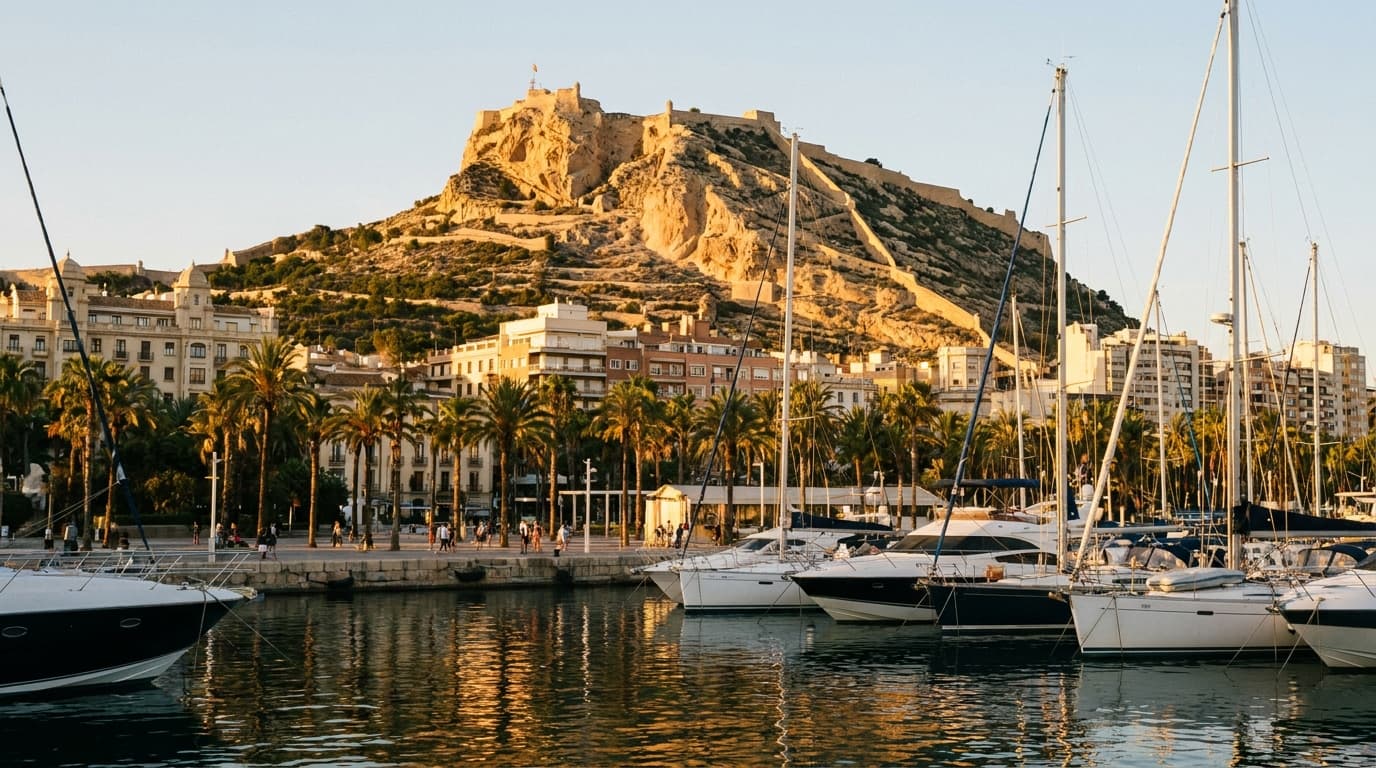
The anchor of the whole panorama is the Castillo de Santa Bárbara, sprawled across the summit of Mount Benacantil, 166 metres above the sea. From the deck of a boat in the bay, the scale of it finally makes sense in a way it never quite does from the streets below: a fortified mountain rising almost straight out of the waterfront, with the castle's walls tracing the ridgeline like a crown that grew there. It is one of the largest medieval fortresses in Spain, and from sea level to summit it dominates every sightline in the bay.
Now for the honest correction. You will read, in more than one glossy write-up, that the castle "glows golden at sunset" when seen from the water. Think about the geometry for a moment and you will see why that cannot be right. From a boat out in the bay, the castle bears roughly north of you. The summer sun, meanwhile, sets well round to the west-northwest. So at sunset the light is raking across the mountain from the side, not shining onto its seaward face. What you actually get is side-light and silhouette: the western edges of the walls and crags catch a rim of warm light while the mass of Benacantil darkens into a magnificent cut-out shape against the colouring sky. (When Spanish sources say the castle "se ilumina" in the evening, they mean the floodlights — which are their own spectacle once darkness falls, the whole fortress etched in artificial gold above the city lights.)
We would argue the honest version is better than the myth. A front-lit castle is a postcard; a silhouetted fortress on a dark mountain, with the sky burning behind the city and the floodlights flickering on as you watch, is a memory.
The Face in the Mountain: When to See the Cara del Moro
Benacantil hides a second trick, and this one is strictly a daytime subject. Seen from the right angle on the water, the seaward cliff of the mountain resolves into a giant human profile — forehead, nose, lips, chin — known as the Cara del Moro, the Moor's Face. It is the unofficial emblem of Alicante, printed on everything from tiles to t-shirts, and the sea is by far the best place to see it, because the profile is carved into the very face of the mountain that looks out over the bay.
Go in the morning or the middle of the day. That is when the sun is on the seaward side of Benacantil and the ridges and hollows that form the face are properly modelled in light and shadow. By evening the face has fallen into the mountain's own shade and the profile flattens out. If the Cara del Moro photograph matters to you — and it should, it is a genuinely strange and wonderful thing — build it into the daylight half of your trip rather than hoping to catch it on a sunset cruise.
Reading the Rest of the Skyline
Once the castle has had its due, let your eye work along the waterfront, because the rest of the city rewards attention:
- The old town (El Barrio) tumbles down the lower slopes of Benacantil towards the sea — a wedge of ochre and white facades, church towers and tiled domes packed between the mountain and the front. From the water you can trace exactly how the city grew: fortress first, fishermen's quarter beneath it, everything else radiating outwards.
- The Explanada de España, Alicante's famous palm-lined promenade with its swirling marble mosaic, reads from the sea as a green ribbon of palms separating the city from the harbour. It was built as the city's front porch, and from a boat you are effectively looking at Alicante the way the Explanada's designers intended it to be presented.
- The marina and harbour sit directly below the promenade, a working mix of yachts, fishing boats and harbour traffic. Leaving it under way — the city opening up behind you as you clear the breakwater — is one of the simple, reliable pleasures of any Alicante boat day.
- Postiguet beach curves away at the foot of Benacantil on the north side, the city beach pressed right up against the mountain — which matters for the next section of this guide.
All of this is on show from the first ten minutes of any outing — whether that is a skippered sightseeing loop, a boat rental in Alicante you helm yourself, or the opening act of a longer day out to the marine reserve on the boat trip to Tabarca.
The Fireworks Contest: Alicante's Best-Kept Boat Secret
Now for the event that genuinely deserves more attention than it gets. Everyone has heard of the Hogueras de Sant Joan, Alicante's great June fiesta, which fills the city from the 20th to the 24th with bonfire sculptures, street parties and the thunder of the daily mascletàs — those daytime gunpowder concerts fired inland at the Plaza de los Luceros, in the middle of the city, well away from the port. The Hogueras are magnificent, but they are fundamentally a street festival: you experience them on foot, in the crowd, inland.
What far fewer people know is what happens after the Hogueras end. From the 25th to the 29th of June, Alicante stages its Concurso de Fuegos Artificiales — a fireworks competition in which pyrotechnic houses take turns, one night each, to outdo one another over the sea off Postiguet and Cocó, at midnight. Five consecutive nights of competition-grade fireworks, fired over the water at the foot of the castle mountain.
Read that geography again: fireworks over the sea, beside a floodlit medieval fortress on a 166-metre mountain, at midnight, for five nights running. The beaches are packed, naturally. The water is not. A boat lying off in the bay gives you the whole composition at once — the bursts overhead, their reflections running towards you across the black water, the illuminated castle standing over it all — with sea room around you and nobody's shoulders in the way. It is, by some distance, the most spectacular thing you can do on a boat in Alicante all year, and it is barely marketed at all. If you are anywhere near the city in the last week of June, this is the night out to plan around; a private evening charter or a boat party in Alicante timed to the contest nights turns a good fireworks display into something close to a private show.
One practical note: midnight fireworks mean a late night on the water. Bring warm layers even in June, agree the timings with your skipper in advance, and treat the evening as a slow, unhurried affair — out in good time, well fed, with the fireworks as the summit of the night rather than a rushed appointment.
Putting a Day (or Night) Together
The pieces above assemble into several honest itineraries, depending on the season and your appetite:
- The classic daylight loop: out of the marina mid-morning, along the front for the Explanada and old town panorama, into position off Postiguet for the Cara del Moro while the light is still on the face, then a swim stop and lunch afloat. Simple, reliable, and the best introduction to the city there is.
- The full day south: use the skyline as your overture and spend the heart of the day at Spain's first marine reserve on the Tabarca excursion — the city view on departure and return brackets the island beautifully.
- The evening run: out in the golden hour, watch Benacantil and the castle go to silhouette as the sun drops towards the west-northwest, then hold position as the floodlights come up and the city switches on. In the last week of June, extend this into the fireworks contest and you have Alicante's finest night afloat.
Alicante does not need embellishing from the water — no invented glow, no inflated legends. A real castle on a real mountain, a working marina under a palm-lined promenade, a face hiding in a cliff, and five midnights a year when the sky over Postiguet catches fire. Come and see the city the way it was arranged to be seen.