There are two Barcelonas. There is the one you know from street level: the queues on the Rambla, the heat radiating off the Eixample pavements, the scrum for a patch of sand at Barceloneta. And there is the one that reveals itself only when you slip out past the breakwater and turn to look back — a city arranged like an amphitheatre between the sea and the dark green wall of the Collserola hills, suddenly quiet, suddenly whole.
Most articles about boating in Barcelona are written by people who have plainly never left the marina. They promise things the geography cannot deliver, and they skip the things that make a day on the water here genuinely special. So this is our honest guide: what you will actually see from the deck, what you won't (however many other websites claim otherwise), how far you can realistically go, and how to plan a day that plays to Barcelona's real strengths.
The First Truth: Barcelona Is a City Charter
Let's deal with the biggest misconception straight away. Barcelona is not the Costa Brava, and it is not the Balearics. If you charter a boat here expecting to hop between turquoise coves, you will be disappointed — not because the boats are wrong, but because the map is.
Here is the distance reality. Heading north from Port Olímpic or Port Vell, a typical four-hour sail gets you to Montgat — a pleasant enough suburban beach town, but not a cove by any stretch. Heading south, the cliffs of the Garraf massif begin around 15 nautical miles out, and the first genuinely wild cove, Cala Morisca, sits roughly 18 nautical miles from the city. Sitges is about 19. On a sailing yacht making 5 to 6 knots, that is a three-to-four-hour passage each way, which leaves you no meaningful time to enjoy the destination on a standard half-day or even full-day charter.
The exception is a fast motor yacht. At around 20 knots, the Garraf coast is 45 minutes away, and a full-day motor charter can genuinely include a swim stop beneath the cliffs before running home. If a cove is non-negotiable for you, that is the boat to book — and you should say so explicitly when you enquire about a yacht charter in Barcelona, so nobody sells you a sailing itinerary that the arithmetic doesn't support.
But here is the thing: once you stop measuring Barcelona against the Costa Brava, the city charter turns out to be a superb product in its own right. The skyline is the destination. And it is a view that, quite literally, millions of people on shore never get.
The Skyline, Landmark by Landmark
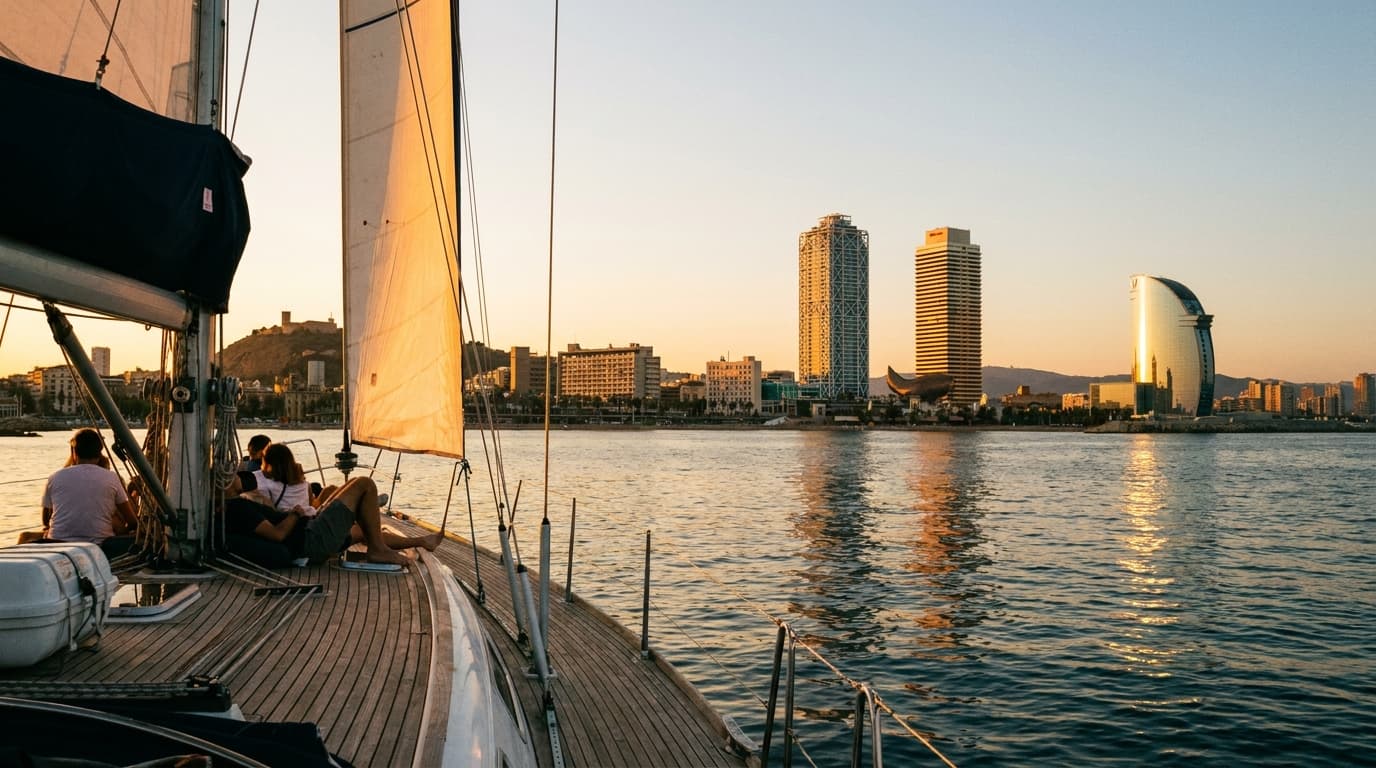
Clear the harbour mouth, put half a mile between yourself and the beach, and the city assembles itself into a panorama that makes sense in a way it never does from inside the grid. Reading from left to right as you face the shore:
Montjuïc and Its Castle
The southern anchor of the view is Montjuïc, the broad, wooded hill that rises straight from the port. From the water you see what road-bound visitors miss: this is a genuine sea cliff, with the 17th-century castle sitting squarely on its brow, exactly where a fortress guarding a harbour ought to be. The whole southern flank of the city climbs its slopes — gardens, the Olympic ring, the cemetery terraces — and from a boat you understand at a glance why this hill decided where Barcelona's port would be.
The W Hotel — the Sail on the Shore
At the seaward tip of Barceloneta stands the W Barcelona, known to everyone as the Hotel Vela — the Sail Hotel. From land it is half-hidden behind the beach clubs; from the water it is unmistakable, a 99-metre curve of mirrored glass that catches and bends the light all day long. It marks the entrance to the old harbour the way a lighthouse might, and it photographs best from exactly where you'll be sitting.
The Cable-Car Towers
Between the W and the beaches, look for the two riveted steel towers of the port cable car, built for the 1929 International Exposition. The little red cabins still creep along the wire between Barceloneta and Montjuïc, and from sea level the towers give the waterfront a pleasingly old-fashioned, mechanical silhouette among all the glass.
Hotel Arts and Torre Mapfre — the Twin Towers
The visual centre of gravity of the whole coastline is the pair of 154-metre towers standing over Port Olímpic: the Hotel Arts, with its exposed steel exoskeleton, and the smooth-skinned Torre Mapfre beside it. Built for the 1992 Olympics, they were the towers that turned Barcelona to face the sea, and from the deck of a boat they read as a gateway — especially in the late afternoon, when the low sun turns the steel lattice of the Arts into glowing filigree.
Collserola, the Green Wall
Behind and above everything runs the ridge of Collserola, crowned by the Tibidabo church and Norman Foster's communications tower. It is the backdrop that makes the amphitheatre: city in the foreground, dark green ridge behind, and you in the front-row seat that floats.
What You Will Not See: the Sagrada Família
Now for the honesty that most boat websites can't bring themselves to print: you cannot see the Sagrada Família from the water. Gaudi's basilica sits well back inside the Eixample grid, and at 172.5 metres it simply does not clear the skyline between itself and the sea — Montjuïc alone rises to 177.7 metres. Every listing that promises you'll "admire the Sagrada Família from the deck" was written by someone selling clicks, not someone who has stood on that deck.
Does it matter? Honestly, no. You did not need a boat to see the Sagrada Família — there's a metro stop for that. You need a boat for the one view of Barcelona that cannot be had any other way: the full sweep of the city between Montjuïc and the Río Besòs, framed by sea and mountain, with nobody standing in front of you.
Swimming: Yes — Just Not at the Beach
A proper Barcelona boat day includes a swim, and it is a much better swim than the one available on shore. You anchor or drift offshore, drop the ladder, and slip into deep, clean, open water — no crowds, no towel-to-towel scrum, no wondering what your feet are about to touch.
A word on water quality, since it comes up. The city monitors its nine beaches continuously, and in a typical season most of them are rated "Excel·lent" — the top grade — with a couple (Barceloneta and Sant Miquel, the busiest, most central strands) coming in at "Bona", the grade below. Offshore, where you'll actually be swimming, you are away from the storm drains and the crowds altogether, in water that is visibly clearer than anything at the sand's edge. It is one of the quiet luxuries of the day: floating on your back a kilometre out, looking up at the whole city, while the beach seethes in the distance.
How to Choose Your Day on the Water
With the geography understood, the choice becomes simple and depends on what you want the day to be:
The classic city cruise. Two to four hours along the seafront: out past the W, along the beaches to the twin towers and the Forum, a swim stop offshore, and back. This is the itinerary that fits the geography perfectly, and it is what a straightforward boat rental in Barcelona does best. You lose nothing by not going further, because the best of the view is right here.
The celebration afloat. Birthdays, stag and hen parties, team days — the seafront cruise with music, a swim stop and a drinks table is an established Barcelona genre for good reason. The city provides the backdrop; you provide the occasion. A dedicated boat party in Barcelona handles the format properly, with a skipper who knows exactly where to anchor for the swim.
The Garraf run. If you genuinely want cliffs and a cove, book a full day on a fast motor yacht and point it south. Forty-five minutes at speed brings you under the ochre cliffs of the Garraf, where the water turns a deeper blue and the coast finally goes wild. It is a different day, at a different price, and it is the only honest way to combine Barcelona with a cove swim.
The evening sail. The last two hours of daylight are, in our view, the best the city offers from the water — low golden light raking across the façade, then the blue hour as a million lights come on. It deserves its own article (and has one), but if that is your inclination, an evening cruise in Barcelona is the booking to make.
The View That Stays With You
Barcelona from the water is not about ticking off monuments. It is about a shift in perspective that no terrace, no viewpoint and no drone shot quite reproduces: the sensation of holding the entire city in a single glance, at anchor, with a swim ladder down and the noise of two million people reduced to a distant shimmer. Go with honest expectations — a city charter, not a cove crawl — and it will be one of the finest afternoons Barcelona gives you.