Let's begin with the sentence that most sunset-cruise pages are terrified to write: in Barcelona, the sun does not set over the sea. It never has and it never will. If you book an evening sail expecting to watch a red disc melt into the Mediterranean horizon, you will spend the golden hour facing the wrong way, wondering whether you've been had.
You haven't been had — you've been mis-sold. Because what actually happens off Barcelona in the last hour of daylight is, in our view, better than a sea sunset. It just needs to be described honestly, which is what this guide is for: the real geometry of the Barcelona evening, what you will actually watch, minute by minute, and how to time a sail so you catch all of it.
The Geometry: Why There Is No Sea Sunset
Barcelona's coastline faces southeast. Stand on the deck looking out to sea and you are looking towards Menorca, not towards the sunset. In summer, the sun goes down in the west-northwest — on a bearing of roughly 289 to 303 degrees depending on the month — which is to say inland, over the city and behind the ridge of Collserola, the wooded hills that wall Barcelona off from the interior.
And there is a second wrinkle the brochures never mention: because Collserola stands several hundred metres above the horizon, the sun disappears behind the ridge around 20 to 25 minutes before the sunset time printed in your weather app. If the app says 21:20, the disc is gone from view by about 21:00. Anyone promising you "champagne as the sun touches the water at 21:20" is describing a city that faces the other way — Lisbon, perhaps, or San Sebastián. Not this one.
One more myth to retire while we're at it: Montjuïc does not "catch the sunset" either. From the water, the hill bears roughly southwest — around 224 degrees — while the sun sets far round to the northwest. At best Montjuïc is side-lit in the evening; the castle does not glow like an ember, whatever the stock photos imply.
What Actually Happens (and Why It's Better)
So the sun sets behind the city. Think about what that means for a moment, because it is the whole secret of the Barcelona evening sail.
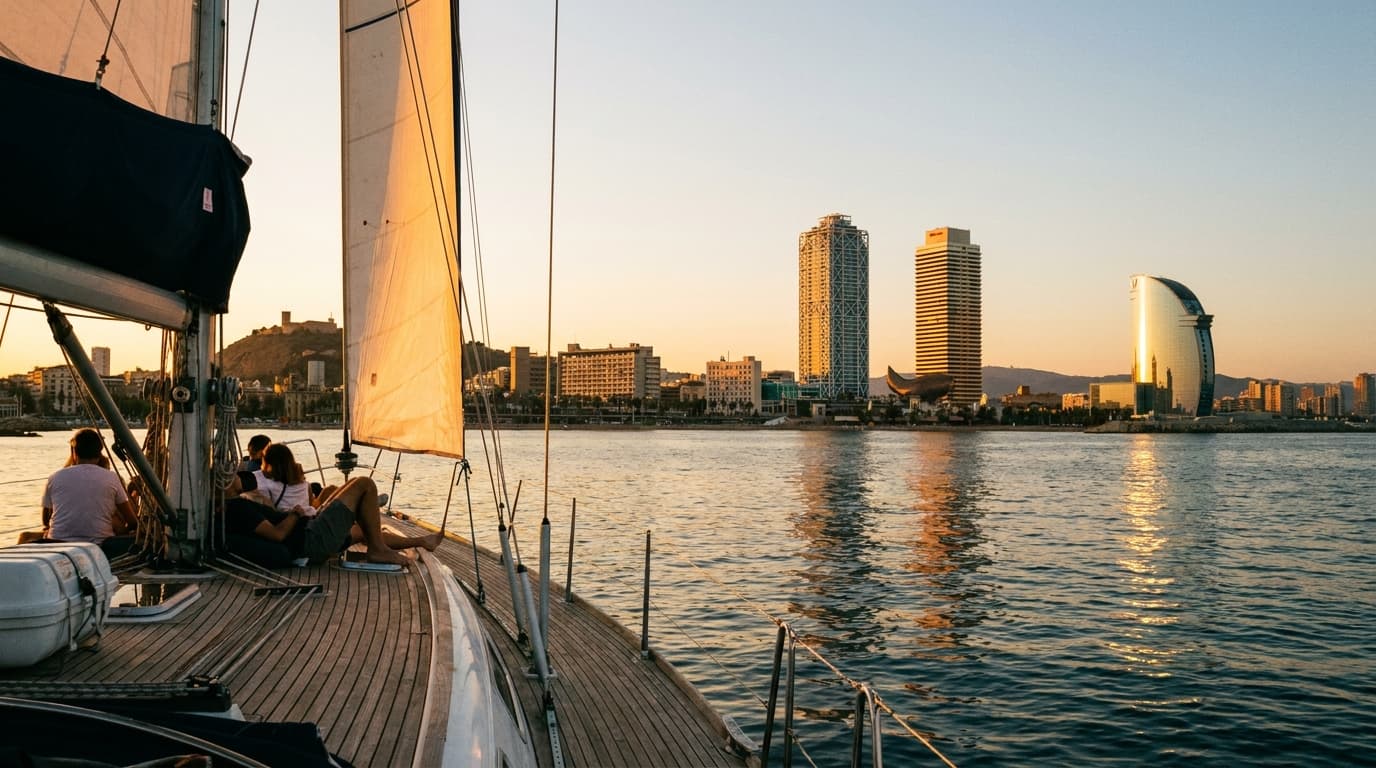
When the sun is low in the northwest and you are afloat in the southeast, the entire city stands between you and the light — lit full in the face. Every façade along the seafront catches the last sun straight on. You are, in effect, sitting in the one seat in the house where Barcelona itself becomes the sunset.
Here is the evening in sequence:
Act One: The Golden Raking Light
In the last 40 minutes or so before the sun drops behind Collserola, the light comes in low and warm across the city. The steel exoskeleton of the Hotel Arts turns to gold filigree; its twin, the Torre Mapfre, becomes a slab of amber; the mirrored sail of the W Hotel bends the whole sky across its face. Behind them, the ridge of Collserola goes from green to deep violet. This is the light photographers plan whole trips around, thrown across an entire city, and the only people who see it face-on are the handful afloat. The millions on shore are standing inside the picture; you are the one looking at it.
Act Two: The Ridge Swallows the Sun
Twenty-odd minutes before official sunset, the disc slips behind Collserola and the direct light switches off — not gradually, but like a hand passing over a lamp. The sky above the ridge stays lit for a long while yet, often in bands of apricot and rose, and the sea around you takes on a pewter stillness that is worth the trip on its own. This is the moment for the first proper drink of the evening.
Act Three: The Blue Hour
Then comes the part that no beach bar and no rooftop can match. As the sky deepens through cobalt towards ink, the city lights come on — first the towers, then the beachfront, then the whole glittering strip from Montjuïc to the Besòs — and you watch a million lamps ignite across an amphitheatre of city from a silent deck offshore. The water goes black and starts carrying reflections. The cable-car towers become chains of lights; the W glows like a lantern at the harbour mouth. If you are going to propose to somebody on a boat in Barcelona, this — not some imaginary horizon sunset — is the moment.
Timing Your Sail
Getting the evening right is a matter of arithmetic, not luck:
Board about two hours before published sunset. That gives you daylight for the first leg along the seafront and a swim stop while the water is still warm and bright.
Be in position an hour before. The golden raking light on the façade is at its best in the last 40 minutes before the sun reaches the ridge — which, remember, happens 20 to 25 minutes ahead of the printed sunset time. Your skipper should have you settled, drink in hand, facing the city, well before then.
Stay for the lights. The commonest mistake is heading in at "sunset". The blue hour — from roughly the printed sunset time until 40 minutes or so after — is the climax of the whole evening. A cruise that docks before dark has sold you the overture and skipped the opera.
In high summer, that translates to boarding around 19:15–19:30 and stepping off around 22:00–22:30. In May or late September the whole schedule shifts earlier and the light, if anything, gets warmer.
The Swim Before the Show
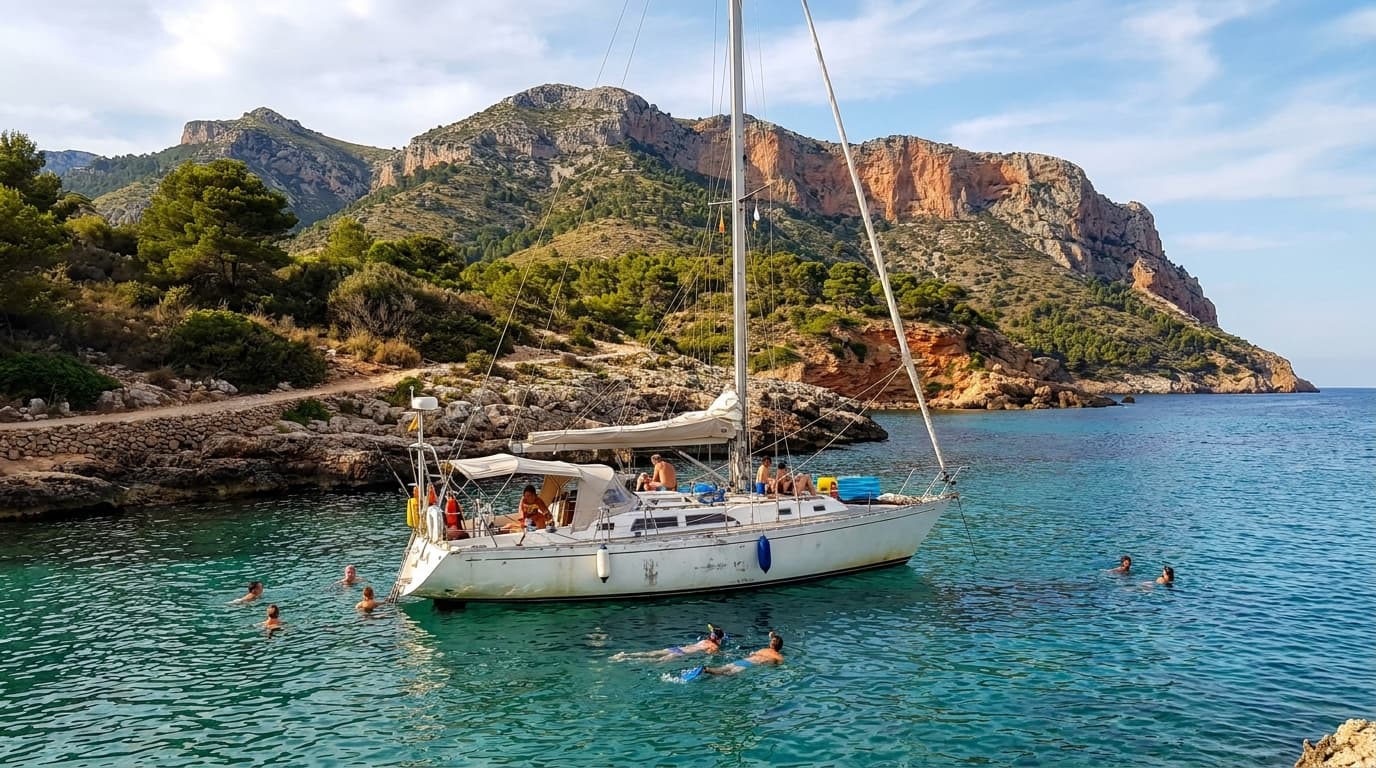
Build a swim into the first half of the evening. You swim offshore, straight off the boat's ladder, in deep open water — clearer and calmer than anything available from the sand, and by early evening the beaches have exhaled their crowds anyway. There is something particularly fine about drying off on deck with a drink as the light begins to turn, salt still on your skin, knowing the best hour is still ahead.
What to Bring
A layer. Even in August, the breeze after sundown has an edge that surprises people who boarded in 30-degree heat. A light jumper or shawl is the single most gratefully received item on any evening sail.
A camera you'll actually use. The two photographic windows are the raking light (city façades, warm and sharp) and the blue hour (lights and reflections — brace your elbows on the rail or use a small tripod, as exposures get long).
Realistic footwear and a dry bag for phones during the swim stop. The boat provides the rest.
Choosing the Right Boat for the Evening
The format matters more in the evening than at any other time of day, because the evening has a shape — swim, light, dusk, lights — and the boat needs to serve it.
For two people, or one couple celebrating something, a skippered romantic evening cruise in Barcelona is the purpose-built option: quiet deck, unhurried pace, and a skipper who knows to put the bow just so as the light comes round. For a group of friends who want the golden hour with music and a glass in hand, an evening boat party in Barcelona runs the same waters with the volume turned up. And if you'd rather compose the evening yourself — your route, your pace, your playlist — a private yacht charter in Barcelona gives you the deck and the decision. Whichever you choose, apply the timing rules above ruthlessly; a beautiful boat on the wrong schedule still misses the show.
The Honest Sell
We could have written the page every other operator writes — the red disc, the horizon, the champagne timed to a sunset you physically cannot see from here. Instead, here is the truthful pitch, which happens to be the stronger one:
Barcelona is one of the very few great cities that turns to face its own sunset audience. From a deck offshore in the last hour of light, you watch a whole city gilded, then dimmed, then re-lit lamp by lamp — a spectacle that belongs exclusively to the people on the water. No sea sunset. Something better.