Ask around the harbour in Alicante and everyone will tell you the same thing: you have to go to Tabarca. What almost nobody tells you is how a private boat trip to the island actually works — where you can go, where you absolutely cannot, and why the rules that protect this extraordinary place are precisely what makes visiting it by charter boat so special. This guide sets all of that out honestly, because Tabarca is governed by a marine reserve regulation with real teeth, and the difference between a magical day and an awkward one is knowing the rules before you cast off.
Tabarca is the only permanently inhabited island in the Comunidad Valenciana: a low, walled sliver of land under two kilometres long, with a fishing village founded in the 18th century by Genoese families ransomed from captivity in Tunis. In 1986 the waters around it became the Reserva Marina de la Isla de Tabarca — Spain's first marine reserve — and four decades of protection have produced water clarity and fish life that have to be seen to be believed. Groupers the size of dogs. Barracuda in silver columns. Posidonia meadows stretching into the blue like underwater wheat fields.
First, the Honest Part: You Cannot Dock or Anchor at Tabarca
Let us deal with the single most important fact up front, because plenty of listings gloss over it. A charter boat cannot tie up at Tabarca, and it cannot anchor there either.
Anchoring anywhere within the marine reserve is prohibited by the regulation that governs it — Orden APA/102/2019, Article 6.1, which bans anchoring outright except in cases of emergency. This is not a technicality that gets waved through in summer; it exists to protect the posidonia seagrass meadows that make the water so clear in the first place, and it is enforced.
What about the island's little port? Tabarca's harbour has just 25 berths, and they are limited to boats of 10 metres' length overall. A charter yacht is longer than that, so there is no berth waiting for you. The boats you see landing streams of day-trippers on the island are the public ferries from Alicante and Santa Pola, which operate their own moorings.
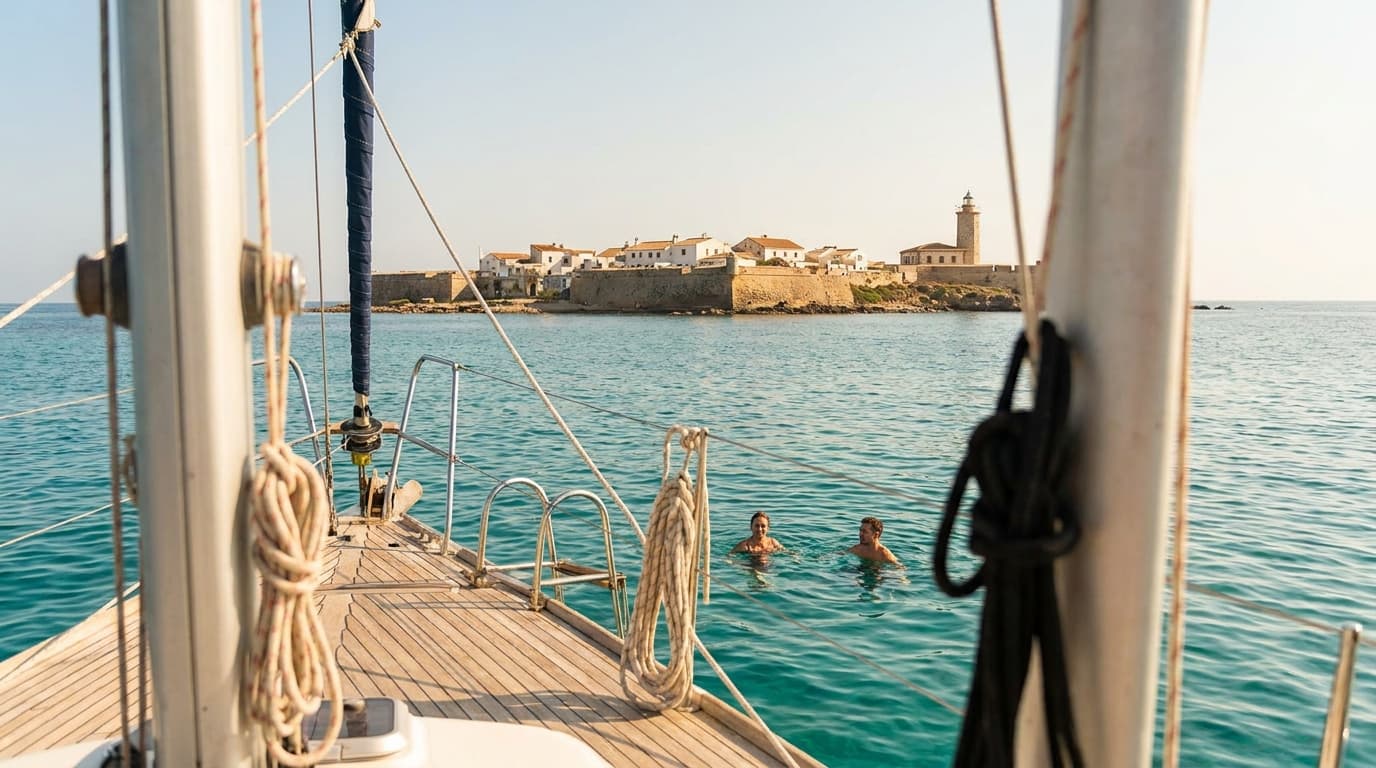
So here is the honest shape of a private trip: you sail to Tabarca, you swim and snorkel directly from the boat in some of the clearest water in the Mediterranean, and you sail back. Swimming and snorkelling are expressly permitted within the reserve — within 200 metres of the beaches and within 50 metres of the rest of the coastline (Article 3.3.b of the same regulation). The ferry crowd lands and queues for paella; the charter crowd floats above groupers in water with 20-metre visibility. We know which side of that trade we would rather be on.
The 6-Knot Myth (It Is a Minimum, Not a Limit)
Here is a piece of misinformation so widespread that we feel obliged to correct it in print: you will read, on many websites, that there is a "6-knot speed limit" inside the Tabarca marine reserve. There is no 6-knot speed limit. The 6 knots is a minimum.
Article 7(a) of Orden APA/102/2019 states that vessels in transit through the reserve must travel at more than 6 knots and less than 10. The logic is straightforward once you see it: the regulation wants boats passing through the reserve to keep moving purposefully — no loitering, no drifting over protected seabed — but slowly enough not to endanger swimmers, divers and wildlife. So the lawful transit band is 6 to 10 knots: brisk enough to be clearly under way, slow enough to be safe. A skipper dawdling at 3 knots through the reserve is as non-compliant as one carving through at 20.
How Far Is It, Really?
Another figure that gets repeated endlessly: "Tabarca is 8 miles from Alicante." It is not. Measure the direct line from Alicante's harbour mouth to the island and you get roughly 10.35 nautical miles — and that is the straight line. A real boat does not sail a ruler-straight course: allowing for the harbour exit, traffic separation and a sensible approach to the reserve boundary, the distance actually sailed works out at around 11.9 nautical miles each way.
Do the arithmetic and the character of the day becomes clear. Nearly 24 nautical miles of round-trip passage, with the final stretch inside the reserve capped at 10 knots by law, plus the hours you actually want in the water — this is a full-day trip, not a four-hour hop. Anyone selling you a quick morning dash to Tabarca and back is either planning to shortchange you on swimming time or is not being straight about the distances. Plan for a whole day, and the island will repay every hour of it.
What the Day Actually Looks Like
A well-run Tabarca day from Alicante follows a rhythm something like this:
- Morning departure from the Marina Real Juan Carlos I, Alicante's harbour, with the Castillo de Santa Bárbara shrinking astern and the low profile of Tabarca gradually resolving out of the haze ahead. The island is flat and easy to miss with the naked eye at first; your skipper will not miss it.
- The passage south — a couple of hours of proper Mediterranean sailing or motoring, past Cabo de Santa Pola, with a decent chance of flying fish and, on lucky days, dolphins working the same waters the Tabarca fishermen have worked for centuries.
- Entering the reserve, where the skipper settles into the lawful 6-to-10-knot transit band and everyone starts staring over the side, because the water changes. It genuinely does. The visibility inside the reserve is of a different order from the coastal water you left behind.
- Swimming and snorkelling off the boat within the permitted zones — inside 200 metres of the beaches, inside 50 metres of the rest of the coast. This is the heart of the day. Bring a mask for every person aboard; the difference between looking at Tabarca's water and looking into it is the difference between a boat ride and a memory.
- Lunch aboard, at whatever pace suits you, followed by more water time or simply lying on deck while the island's walled village sits postcard-still off the beam.
- The return passage in the softer afternoon light, arriving back in Alicante with the salt dried on your shoulders and the firm conviction that the ferry passengers got the lesser deal.
If that sounds like your kind of day, our dedicated boat trip to Tabarca runs exactly this format from Alicante's marina.
One More Boundary to Respect: the Bajo de la Llosa
The reserve is not uniform. Its crown jewel is the Bajo de la Llosa, a shoal designated as an integral (fully protected) zone under Article 2.1 of the regulation. No entry, no exceptions — not for swimming, not for snorkelling, not for transit. It functions as the reserve's nursery, the untouched core from which fish spill out into the surrounding waters, and it is a large part of why the snorkelling everywhere else around Tabarca is so absurdly good. A professional skipper knows the boundary and stays clear of it; if you are ever aboard a boat whose skipper does not seem to know where the Llosa is, that tells you everything you need to know about the operation.
What to Bring
Tabarca days are simple to pack for, but the essentials matter more than usual because you will be spending the day off a boat rather than on a beach with facilities:
- Snorkelling gear for everyone. This is non-negotiable at Tabarca. If the boat provides masks, check the count before departure.
- Reef-safe sunscreen, applied before you jump in rather than after. You are swimming over the best-preserved posidonia meadows on this coast; keep the chemistry out of them.
- Water and food — at least two litres of water per person on a summer day. You will not be popping ashore to a beach bar.
- A hat, sunglasses and a long-sleeved cover-up. There is very little shade on the water and the passage adds up to several hours of exposure.
- A windproof layer for the return leg. Even in August, the afternoon breeze over 12 miles of open water can feel fresher than you expect.
When to Go
The season runs from May to October. June and September are the sweet spots: warm water, settled weather and far less traffic inside the reserve than in the July-August peak, when the anchorage-free waters around the island still manage to feel busy with ferries and day boats. Early departures beat late ones in every month — the sea is calmer, the light through the water is better for snorkelling, and you arrive before the ferry waves do. Keep an eye on easterly winds, which can make the passage lumpy; your skipper will make the final call, and a postponed Tabarca day is always better than a green-faced one.
Booking It
You have two sensible routes. The first is our skippered Tabarca excursion, where the navigation, the reserve rules and the timing are all handled for you — the right choice for most groups. The second, if you have qualified sailors aboard or want a boat for more than the island run, is a boat rental in Alicante with or without skipper, which opens up Tabarca alongside the rest of the bay. And if the island day is the centrepiece of a bigger celebration, it pairs remarkably well with an evening boat party in Alicante — Tabarca by day, the city lights from the water by night.
However you do it, do it honestly: no anchor, no dock, no myths about speed limits — just one of the clearest stretches of water in Spain, a boat, and a whole day to enjoy them properly.